

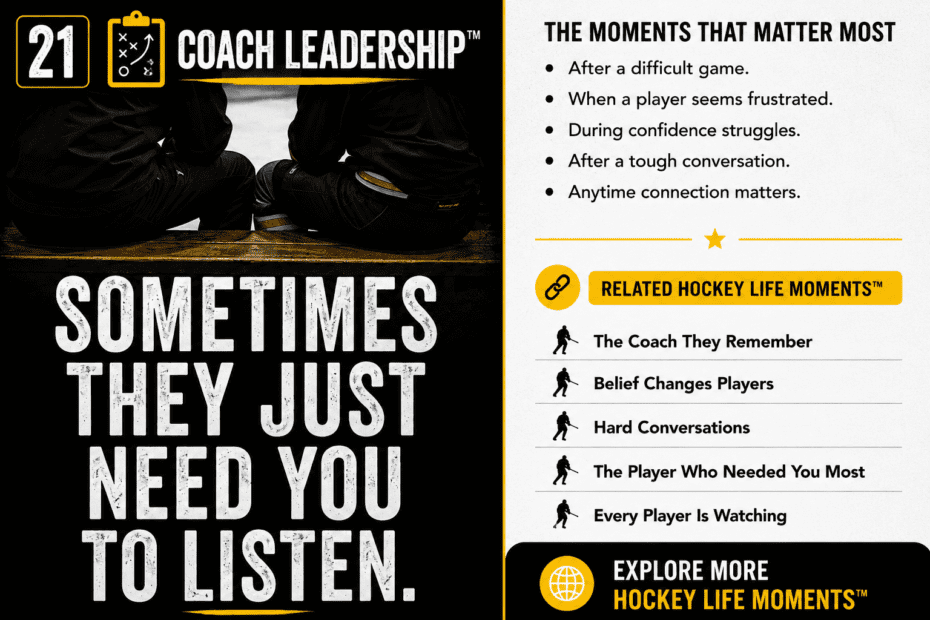
Coach Leadership™
Coaches are natural problem solvers.
A player struggles with skating.
The coach teaches technique.
A player struggles with positioning.
The coach explains systems.
A player struggles with confidence.
The coach looks for solutions.
That instinct is one of the reasons coaches become coaches in the first place.
They want to help.
They want to teach.
They want players to improve.
But sometimes the most important thing a coach can do is not teach.
It’s listen.
Modern athletes carry more pressure than many people realize.
There is pressure to perform.
Pressure
to make teams.
to earn ice time.
from school.
from social media.
from friends.
they place on themselves.
Many players arrive at the rink carrying challenges unrelated to hockey.
Family situations.
Academic stress.
Friendship issues.
Mental health struggles.
Confidence problems.
Fear of failure.
The coach may never know the entire story.
But coaches often have an opportunity to make a difference.
Not because they have all the answers.
Because they are willing to listen.
Many players are not looking for solutions.
They are looking for understanding.
They are looking for someone who cares enough to hear them.
Someone who will not:
interrupt.
immediately judge.
immediately begin correcting.
simply listen.
This can feel uncomfortable for coaches.
Listening does not always feel productive.
It does not appear on practice plans.
It does not improve power-play percentages.
It does not show up in statistics.
Yet some of the most impactful coaching moments happen through conversation.
A player who feels
heard often feels valued.
valued often gains confidence.
confidence often performs better.
The connection between listening and development is stronger than many coaches realize.
Years later, players rarely remember every drill.
They rarely remember every practice plan.
They rarely remember every system.
But they often remember the coach who took time to talk.
The coach who stayed after practice.
The coach who checked in.
The coach who asked how things were going.
The coach who listened.
Listening does not mean lowering standards.
Listening does not mean avoiding accountability.
Listening simply means recognizing that players are people before they are athletes.
People with emotions.
People with challenges.
People with lives beyond the rink.
The best coaches understand both sides of the role.
They teach hockey.
But they also build relationships.
Those relationships create trust.
And trust creates influence.
Many coaches spend years trying to become better instructors.
That matters.
But some of the most respected coaches become great listeners first.
Because players do not always need advice.
Sometimes they simply need to know someone cares.
Sometimes they need a conversation more than a correction.
Sometimes they need a listener more than a coach.
And sometimes the most important coaching moment of the season happens long after practice ends.
On a quiet bench.
In an empty arena.
During a conversation nobody else will ever see.
When To Revisit This Moment
• After a difficult game.
• When a player seems frustrated.
• During confidence struggles.
• After a tough conversation.
• Anytime connection matters.
Related Hockey Life Moments™
• The Coach They Remember
• Belief Changes Players
• Hard Conversations
• The Player Who Needed You Most
• Every Player Is Watching
Coach Leadership™
The Right Perspective For The Right Moment™
Presented by The Hockey Resource™
North American Hockey Media Company
PRESENTED BY: thehockeyresource.com and thehockeytournamentresource.com – mark@thehockeyresource.com
As always, thank you for being part of The Hockey Resource community.
Mark Hetherman
Executive Director
The Hockey Resource
thehockeytournamentresource.com