

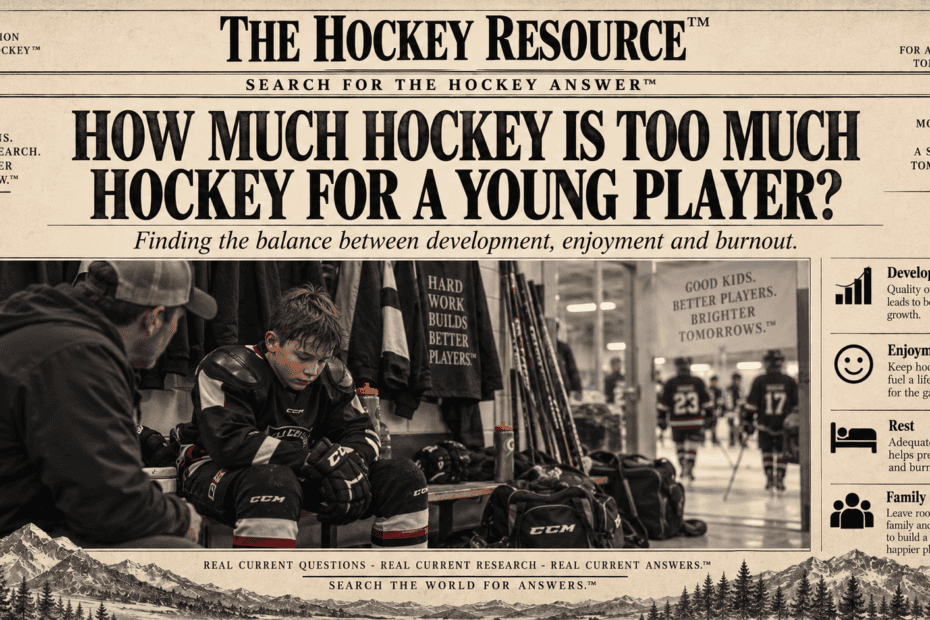
Winning matters in youth Hockey. So does development. The problem begins when winning today’s game becomes more important than preparing tomorrow’s Player.
The Hockey Tournament Resource Answer™
Coaches should teach Players to compete and strive to win, while ensuring that every Player has meaningful opportunities to learn. Winning and development are not opposing goals. Strong development makes better competition possible.
When winning becomes a problem
Consider a Coach who regularly shortens the bench, double-shifts the strongest Players and avoids using developing Players in challenging situations. That approach might help win a particular game, but over a season it can limit the experience and confidence of everyone else.
The strongest Players receive more puck touches, difficult assignments and opportunities to recover after errors. Meanwhile, other Players lose the very repetitions that could help them improve. This is not only a playing-time issue. It is a development opportunity issue.
Mistakes are part of learning
A young Defenceman attempts a breakout pass and an opponent intercepts it. The Coach has a choice: punish the error or investigate what happened. Did the Player recognize the pressure? Was support available? Was the decision sound but the execution poor? The answer determines what to teach next.
Accountability is important. However, a learning environment should not teach Players to be afraid of every difficult decision. Even NHL Players make mistakes. Young Players need the chance to learn from theirs and try again.
Every roster spot deserves a development plan
A Coach should be able to explain how the Team is helping its first-line centre, sixth Defenceman, backup Goalie, late-developing skater and Player struggling with confidence. Those plans need not be identical, but no Player should be forgotten simply because another is producing more points.
The balance changes with age
At older competitive levels, roles become specialized, special teams matter more and ice time may become less equal. That does not remove a Coach’s responsibility to develop Players. It means expectations, feedback and individual development plans must become more specific.
What Hockey Parents should ask
Rather than judging an entire season by standings, ask whether Players are learning, receiving useful feedback, becoming more capable, recovering from mistakes and gradually handling greater responsibilities. A single game seldom answers those questions. A season often provides a clearer picture.
President Mark’s takeaway
A championship can become a lasting Hockey memory. But the scoreboard records one result, while development stays with the Player. The best youth Hockey programs compete to win without sacrificing the growth of the people wearing their jerseys.
PARTICIPANTS WORK IN THE GAME. WE WORK ON IMPROVING THE GAME.™
As always, thank you for being part of The Hockey Resource Community.
AMAZON Hockey https://thehockeyresource.com/hockey-products-amazon/
NEW Tournament Search APP
https://play.google.com/store/apps/details?id=com.hockeyresource.hockeytournamentapp&hl=en_CA&pli=1
GUMROAD – eBooks
https://thehockeyresource.gumroad.com/
SEE My Interview with the Mental Health Academy
https://www.buzzsprout.com/1824112/episodes/13519482
https://thehockeytournamentresource.com/parent-questions-your-answers/
HOW WE REACHED THE HOCKEY ANSWER™
At The Hockey Tournament Resource™, we believe Hockey families, Players, Coaches and Officials deserve more than opinions. They deserve answers supported by research, experience and practical understanding of the game.
Every question begins with something Hockey people genuinely want to know.
OUR RESEARCH PROCESS
- WE FIND REAL QUESTIONS. We investigate what Hockey Players, Parents, Coaches and Officials are asking and searching for.
- WE SEARCH THE WORLD FOR ANSWERS. We examine relevant Hockey knowledge, coaching practices, available research and expert perspectives from around the world.
- WE COMPARE THE EVIDENCE. We look beyond individual opinions, consider different approaches and identify where the strongest available evidence points.
- WE APPLY REAL HOCKEY EXPERIENCE. We consider how the findings apply to actual Hockey situations, including different ages, skill levels and stages of development.
- WE DELIVER A PRACTICAL ANSWER. We explain what our research suggests, why it matters and what Hockey people can do with that information.
We recognize that not every Hockey question has one perfect answer. Age, ability, experience and individual circumstances can change what works best.
Our commitment is to provide thoughtful, practical answers while being clear about what the evidence supports and where uncertainty remains.
REAL CURRENT QUESTIONS. REAL CURRENT RESEARCH. REAL CURRENT ANSWERS.™
SEARCH THE WORLD FOR ANSWERS.™
The Hockey Tournament Resource™
LEARN WHEN IT FITS YOUR LIFE.™
