

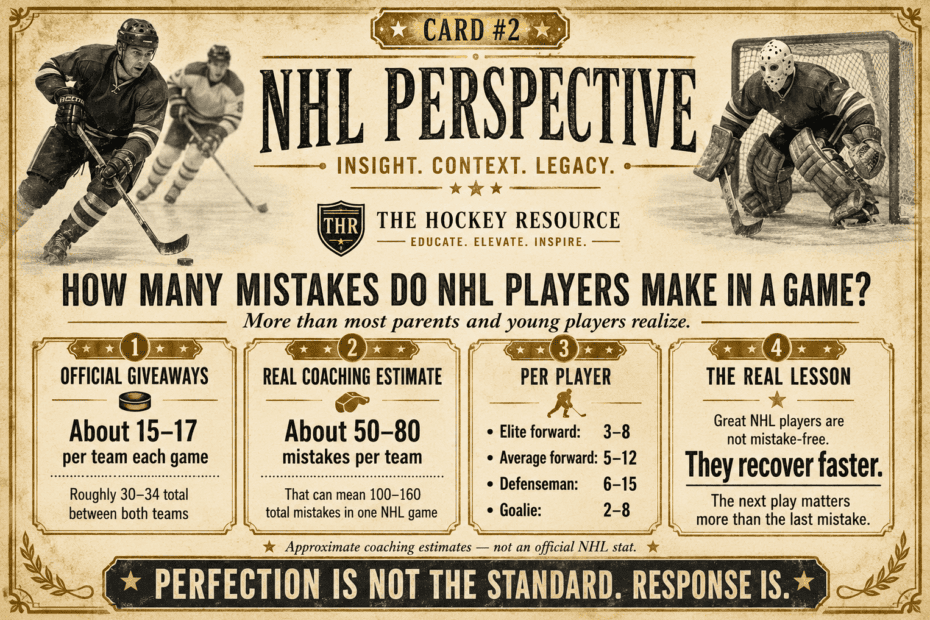
President Mark — Even in the NHL. Junior · Shooting ·
President Mark’s Junior shooting lesson connects an NHL example to a specific conversation between Coach and Player, and between Coach and Parent. A Player judges a productive attacking shift only by whether a goal is scored.
The immediate learning goal is: Assess chance quality, execution, and the following play separately. These are suggested THR conversations. They are not quotations from NHL Coaches or a claim that children should perform at NHL speed.
Begin with the NHL perspective
Alex Ovechkin recorded 65 goals on 446 shots on goal in 2007–08. That leaves 381 shots on goal that did not score. Capitals statistical record.
Those 381 were not 381 missed nets or proven bad decisions. Shots on goal include goals and saved shots; missed and blocked attempts are different categories. Evaluate the chance before correcting the shooter.
Why the instruction fits Junior
Respect the adult or near-adult Player’s ownership. Be honest about role expectations and consequences, and provide a specific route to improvement.
For this lesson, keep the target narrow: Assess chance quality, execution and the following play separately. The Player should understand the action and have a suitable chance to try it. Adjust the pace and difficulty to match experience, rather than assuming everyone in the age group can handle the same pressure.
Coach Q&A: What should I say to the Player?
Coach: “Even NHL scorers have good shots stopped. Johnny, judge the chance and execution separately. What would improve that same opportunity?”
Johnny: “I had chances, so why didn’t I finish?”
Coach: “Assess chance quality, execution and the following play separately. Let’s agree on how you will practice it and when we will review the next opportunities.”
Listen to the real explanation before choosing the correction. Check whether the problem was the read, the execution, an opponent’s play or an unclear instruction.
Coach to Parent: explain the same lesson
Parent: “Should I send him scoring statistics after every game?”
Coach: “Even NHL scorers have good shots stopped. The Player and Coach will review relevant opportunities and agree on a measurable practice focus. The learning goal is simple: Assess chance quality, execution and the following play separately. What I will watch for is this: The Player uses specific evidence and practices an agreed detail.”
Support at home: Let the Player lead the performance discussion and decide what support they want from family.
Practice it with Junior Players
1. Select a small sample of relevant opportunities with the Player.
2. Ask what information supported the choice and what execution could improve.
3. Practice the chosen detail and agree on what the next review will examine.
Use the activity or review as a starting point, then connect it to the Player’s role and the staff’s actual expectations.
What recovery looks like
The Player uses specific evidence and practices an agreed detail.
Notice the adjustment specifically. A useful next action can occur even if the next result is imperfect. If the same difficulty returns, change the demonstration, the practice conditions or the amount of information.
Keep the expectation clear: The NHL comparison does not mean every shot is a good shot. If a better passing option was clearly available, teach that read.
Age-specific takeaway: This matches the Junior learning goal: Assess chance quality, execution and the following play separately. The Player uses specific evidence and practices an agreed detail.
Take one conversation to the rink
The shared message is: Even NHL scorers have good shots stopped. Assess chance quality, execution and the following play separately. The Coach teaches the action; the Parent understands the focus and supports the Player’s next opportunity.
In House League, the primary objective is to have fun. Advancement programs should explain role expectations honestly. In every setting, speak respectfully and make the next instruction clear.
See this theme across all five age groups. · Explore President Mark’s complete Even in the NHL series.
The Hockey Resource™ — We Make Better Hockey People.™

As always, thank you for being part of The Hockey Resource Community.
AMAZON Hockey https://thehockeyresource.com/hockey-products-amazon/
NEW Tournament Search APP
https://play.google.com/store/apps/details?id=com.hockeyresource.hockeytournamentapp&hl=en_CA&pli=1
GUMROAD – eBooks
https://thehockeyresource.gumroad.com/
SEE My Interview with the Mental Health Academy
https://www.buzzsprout.com/1824112/episodes/13519482
https://thehockeytournamentresource.com/parent-questions-your-answers/
HOW WE REACHED THE HOCKEY ANSWER™
At The Hockey Tournament Resource™, we believe Hockey families, Players, Coaches and Officials deserve more than opinions. They deserve answers supported by research, experience and practical understanding of the game.
Every question begins with something Hockey people genuinely want to know.
OUR RESEARCH PROCESS
- WE FIND REAL QUESTIONS. We investigate what Hockey Players, Parents, Coaches and Officials are asking and searching for.
- WE SEARCH THE WORLD FOR ANSWERS. We examine relevant Hockey knowledge, coaching practices, available research and expert perspectives from around the world.
- WE COMPARE THE EVIDENCE. We look beyond individual opinions, consider different approaches and identify where the strongest available evidence points.
- WE APPLY REAL HOCKEY EXPERIENCE. We consider how the findings apply to actual Hockey situations, including different ages, skill levels and stages of development.
- WE DELIVER A PRACTICAL ANSWER. We explain what our research suggests, why it matters and what Hockey people can do with that information.
We recognize that not every Hockey question has one perfect answer. Age, ability, experience and individual circumstances can change what works best.
Our commitment is to provide thoughtful, practical answers while being clear about what the evidence supports and where uncertainty remains.
REAL CURRENT QUESTIONS. REAL CURRENT RESEARCH. REAL CURRENT ANSWERS.™
SEARCH THE WORLD FOR ANSWERS.™
The Hockey Tournament Resource™
LEARN WHEN IT FITS YOUR LIFE.™