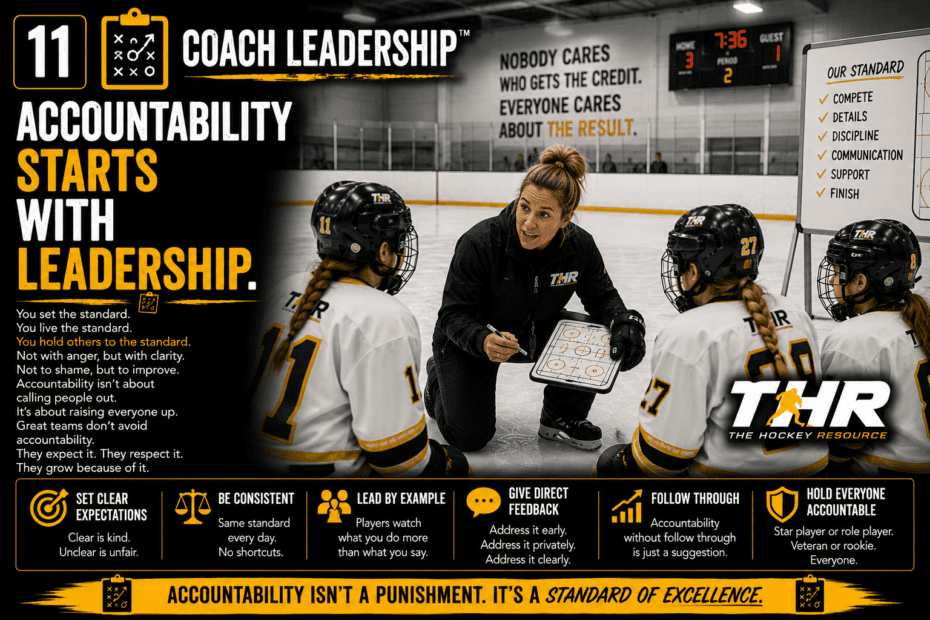
Players Follow What Leaders Model
Every coach wants accountable players.
Most organizations want accountable teams.
Many leaders discuss responsibility regularly.
Far fewer demonstrate it consistently.
Accountability is often viewed as something coaches demand from players. Great leaders understand a different reality.
Accountability begins with leadership.
Before athletes accept responsibility for mistakes, effort, preparation, and behavior, they need to see those same expectations modeled by the adults guiding them.
Because of this, leadership credibility is built through example.
The strongest teams are rarely led by leaders who simply talk about accountability.
Successful teams are led by leaders who live it.
Accountability Is More Than Discipline
Many people associate accountability with punishment.
Others connect accountability with consequences.
Effective leadership views accountability differently.
At its core, accountability means taking ownership.
Ownership of decisions.
Ownership of preparation.
Ownership of communication.
Ownership of mistakes.
Ownership of outcomes.
As a result, accountability becomes a tool for growth rather than a mechanism for control.
When coaches approach accountability in this way, players become more willing to embrace it themselves.
Leadership Sets the Tone
Team culture begins at the top.
Players observe coaches constantly.
Athletes notice preparation.
They evaluate communication.
They watch how leaders respond when things go wrong.
Consequently, every coaching action sends a message.
A coach who arrives prepared teaches preparation.
A coach who admits mistakes teaches humility.
A coach who accepts responsibility teaches accountability.
Over time, those lessons become embedded within team culture.
Trust and Accountability Are Connected
Trust cannot exist without accountability.
Likewise, accountability struggles without trust.
Players accept difficult feedback when they trust the person providing it.
Athletes respond positively to correction when they believe it comes from a place of support and development.
Because trust and accountability reinforce one another, effective leaders focus on both.
The strongest cultures balance high standards with strong relationships.
That combination creates environments where accountability feels productive rather than punitive.
Coaches Must Own Their Mistakes
Every leader makes mistakes.
Game decisions sometimes fail.
Communication occasionally falls short.
Evaluations are not always perfect.
The difference lies in how leaders respond.
Strong coaches acknowledge mistakes.
Trusted leaders accept responsibility.
Respected coaches avoid excuses.
When athletes witness those behaviors, they learn that accountability applies to everyone.
No one is above the standard.
Not even the coach.
Consistency Creates Credibility
Players value fairness.
Athletes appreciate consistency.
Teams thrive when standards remain clear.
Accountability loses effectiveness when expectations change depending on circumstances.
Selective enforcement creates frustration.
Favoritism damages trust.
Inconsistent leadership weakens culture.
For that reason, strong coaches apply standards fairly across the entire roster.
Consistency strengthens credibility.
Credibility strengthens leadership.
Leadership strengthens culture.
Difficult Conversations Require Accountability
Leadership often involves uncomfortable discussions.
Playing time concerns.
Effort issues.
Team behavior.
Performance challenges.
Those conversations cannot be avoided.
Successful coaches address issues directly while maintaining respect.
Constructive feedback helps athletes grow.
Honest communication creates clarity.
Clear expectations reduce confusion.
Consequently, accountability becomes easier when communication remains open and consistent.
Accountability Creates Better Teammates
Player development extends beyond individual performance.
Teams become stronger when athletes hold themselves accountable to one another.
Reliable teammates create trust.
Responsible teammates strengthen culture.
Committed teammates improve standards.
Because accountability influences the entire group, coaches should encourage players to take ownership of their role within the team.
Strong cultures emerge when accountability becomes shared rather than imposed.
Character Is Built Through Responsibility
Every challenge presents a choice.
Players can blame circumstances.
Athletes can make excuses.
Individuals can accept responsibility and learn.
Great leaders help athletes choose growth.
Responsibility develops resilience.
Ownership builds confidence.
Accountability strengthens character.
Those lessons extend far beyond hockey.
Long after careers end, accountability remains valuable in school, business, family, and community life.
The Legacy of Accountable Leadership
Championships are important.
Development matters.
Culture matters.
Leadership matters most.
Players may forget systems and strategies over time.
Athletes often remember examples.
They remember coaches who practiced what they preached.
They remember leaders who accepted responsibility.
They remember adults who held themselves to the same standards expected from others.
Accountability starts with leadership.
Every expectation begins with example.
Every standard begins with consistency.
Every culture begins with trust.
The best coaches understand a simple truth.
If leaders want accountability from players, they must demonstrate accountability first.
PRESENTED BY: thehockeyresource.com and thehockeytournamentresource.com – mark@thehockeyresource.com
As always, thank you for being part of The Hockey Resource Community.
AMAZON Hockey https://thehockeyresource.com/hockey-products-amazon/
NEW Tournament Search APP
https://play.google.com/store/apps/details?id=com.hockeyresource.hockeytournamentapp&hl=en_CA&pli=1
GUMROAD – eBooks
https://thehockeyresource.gumroad.com/
SEE My Interview with the Mental Health Academy
https://www.buzzsprout.com/1824112/episodes/13519482
https://thehockeytournamentresource.com/parent-questions-your-answers/
HOW WE REACHED THE HOCKEY ANSWER™
At The Hockey Tournament Resource™, we believe Hockey families, Players, Coaches and Officials deserve more than opinions. They deserve answers supported by research, experience and practical understanding of the game.
Every question begins with something Hockey people genuinely want to know.
OUR RESEARCH PROCESS
- WE FIND REAL QUESTIONS. We investigate what Hockey Players, Parents, Coaches and Officials are asking and searching for.
- WE SEARCH THE WORLD FOR ANSWERS. We examine relevant Hockey knowledge, coaching practices, available research and expert perspectives from around the world.
- WE COMPARE THE EVIDENCE. We look beyond individual opinions, consider different approaches and identify where the strongest available evidence points.
- WE APPLY REAL HOCKEY EXPERIENCE. We consider how the findings apply to actual Hockey situations, including different ages, skill levels and stages of development.
- WE DELIVER A PRACTICAL ANSWER. We explain what our research suggests, why it matters and what Hockey people can do with that information.
We recognize that not every Hockey question has one perfect answer. Age, ability, experience and individual circumstances can change what works best.
We commit to providing thoughtful, practical answers while being clear about what the evidence supports and where uncertainty remains.
REAL CURRENT QUESTIONS. REAL CURRENT RESEARCH. REAL CURRENT ANSWERS.™
SEARCH THE WORLD FOR ANSWERS.™
The Hockey Tournament Resource™
LEARN WHEN IT FITS YOUR LIFE.™