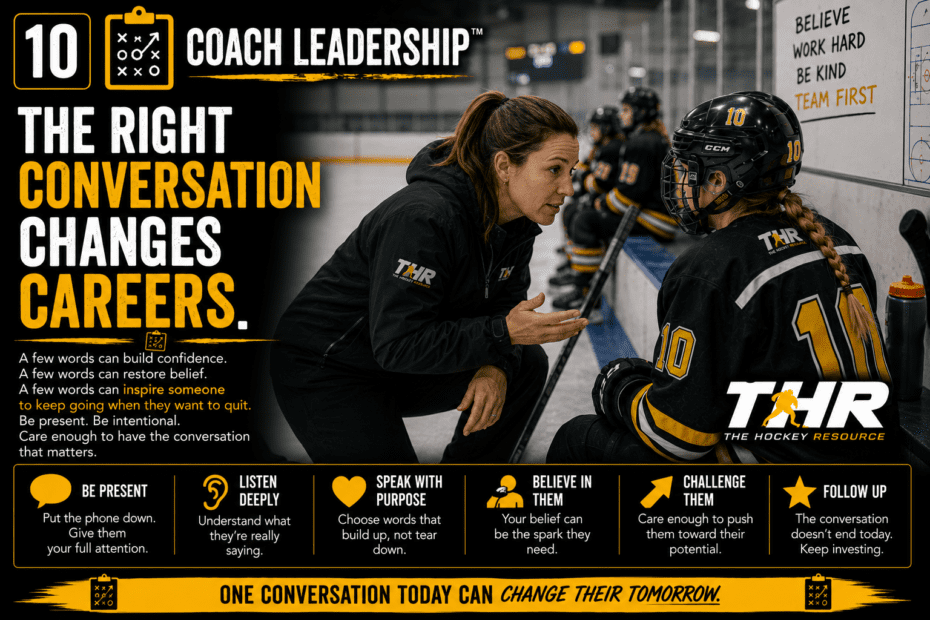
Coaches Often Influence More Than They Realize
Most hockey coaches focus on practices.
Game plans receive significant attention.
Player development remains a daily priority.
Competition naturally dominates many discussions.
Yet some of the most important coaching moments happen away from the ice.
A short conversation.
A few encouraging words.
An honest discussion.
A moment of belief.
Those interactions may last only minutes.
Their impact can last a lifetime.
Because leadership is ultimately about influence, conversations often become one of the most powerful tools available to a coach.
Players Remember Conversations
Athletes frequently forget drills.
Many struggle to recall specific games.
Tournament results eventually fade.
Conversations often remain.
Years later, former players can still remember:
- The coach who believed in them.
- The coach who challenged them.
- The coach who encouraged them.
- The coach who helped them through adversity.
- The coach who changed their perspective.
Words matter.
Timing matters.
Leadership often appears through communication.
As a result, every conversation carries potential influence.
Confidence Can Be Created in a Moment
Young athletes regularly battle self-doubt.
Competition creates pressure.
Mistakes create frustration.
Setbacks create uncertainty.
During those moments, coaches have opportunities to change how players see themselves.
A simple statement can create confidence.
A thoughtful observation can unlock potential.
An encouraging conversation can restore belief.
Many successful athletes point to a coach who helped them recognize strengths they could not yet see themselves.
That influence frequently becomes a turning point.
Honest Conversations Build Trust
Players appreciate honesty.
Athletes value clarity.
Development improves when expectations are understood.
Strong coaches avoid misleading players.
Instead, they communicate openly and respectfully.
Honest conversations might include:
- Areas requiring improvement.
- Opportunities for growth.
- Future goals.
- Team expectations.
- Leadership responsibilities.
Although difficult discussions can feel uncomfortable, transparency builds credibility.
Credibility strengthens trust.
Trust strengthens relationships.
Difficult Conversations Are Part of Leadership
Leadership is not limited to encouragement.
Certain situations require accountability.
Some moments demand difficult conversations.
Playing time discussions.
Effort concerns.
Behavioral issues.
Team conflicts.
Performance challenges.
Great coaches address these situations directly while maintaining respect.
Effective leaders focus on solutions rather than blame.
Because of that approach, difficult conversations become opportunities for growth.
Listening Is Often More Powerful Than Talking
Many coaches concentrate on delivering messages.
Exceptional coaches also listen.
Players often reveal valuable information when given an opportunity to speak.
Concerns become visible.
Challenges become understandable.
Perspectives become clearer.
Listening demonstrates respect.
Listening builds trust.
Listening strengthens relationships.
Consequently, strong communication requires both speaking and listening.
The most impactful conversations are often two-way discussions.
Every Player Needs Something Different
Athletes do not all respond the same way.
One player may need encouragement.
Another may need accountability.
Certain athletes require reassurance.
Others benefit from increased challenge.
Effective coaches adjust communication to individual needs.
Understanding personalities helps leaders communicate more effectively.
Personalized conversations create stronger connections.
Stronger connections improve development.
Career-Changing Conversations Often Happen Unexpectedly
Many influential conversations are not planned.
A discussion after practice.
A chat during a road trip.
A moment following disappointment.
A conversation after being cut from a team.
An interaction after a breakthrough performance.
Those situations create opportunities for leadership.
Athletes are often most receptive when emotions are high and uncertainty exists.
A coach who provides perspective during those moments can influence future decisions, confidence levels, and career paths.
Communication Creates Culture
Team culture is built through communication.
Respectful conversations strengthen relationships.
Honest communication reduces confusion.
Constructive feedback encourages growth.
Supportive interactions build confidence.
When coaches communicate effectively, culture improves.
As culture improves, trust grows.
As trust grows, teams become stronger.
Everything becomes connected.
The Legacy of a Conversation
Many coaches never realize the impact of their words.
Years later, former players often share stories.
They remember encouragement.
They remember belief.
They remember guidance.
They remember support during difficult times.
Rarely do those stories focus on systems or tactics.
Most focus on conversations.
That reality highlights the true influence of coaching.
Leadership is not simply about directing players.
Leadership is about helping people see possibilities they may not yet see themselves.
The right conversation can change a season.
The right conversation can change confidence.
The right conversation can change a career.
Great coaches understand that every conversation carries that potential.
As always, thank you for being part of The Hockey Resource Community.
AMAZON Hockey https://thehockeyresource.com/hockey-products-amazon/
NEW Tournament Search APP
https://play.google.com/store/apps/details?id=com.hockeyresource.hockeytournamentapp&hl=en_CA&pli=1
GUMROAD – eBooks
https://thehockeyresource.gumroad.com/
SEE My Interview with the Mental Health Academy
https://www.buzzsprout.com/1824112/episodes/13519482
https://thehockeytournamentresource.com/parent-questions-your-answers/
HOW WE REACHED THE HOCKEY ANSWER™
At The Hockey Tournament Resource™, we believe Hockey families, Players, Coaches and Officials deserve more than opinions. They deserve answers supported by research, experience and practical understanding of the game.
Every question begins with something Hockey people genuinely want to know.
OUR RESEARCH PROCESS
- WE FIND REAL QUESTIONS. We investigate what Hockey Players, Parents, Coaches and Officials are asking and searching for.
- WE SEARCH THE WORLD FOR ANSWERS. We examine relevant Hockey knowledge, coaching practices, available research and expert perspectives from around the world.
- WE COMPARE THE EVIDENCE. We look beyond individual opinions, consider different approaches and identify where the strongest available evidence points.
- WE APPLY REAL HOCKEY EXPERIENCE. We consider how the findings apply to actual Hockey situations, including different ages, skill levels and stages of development.
- WE DELIVER A PRACTICAL ANSWER. We explain what our research suggests, why it matters and what Hockey people can do with that information.
We recognize that not every Hockey question has one perfect answer. Age, ability, experience and individual circumstances can change what works best.
Our commitment is to provide thoughtful, practical answers while being clear about what the evidence supports and where uncertainty remains.
REAL CURRENT QUESTIONS. REAL CURRENT RESEARCH. REAL CURRENT ANSWERS.™
SEARCH THE WORLD FOR ANSWERS.™
The Hockey Tournament Resource™
LEARN WHEN IT FITS YOUR LIFE.™