Consistency Is the Foundation of Leadership
Every successful hockey program has standards.
Winning organizations establish expectations.
Strong leaders create accountability.
Great coaches enforce consistency.
Problems begin when standards change depending on who is involved.
Athletes notice quickly when rules apply differently to different players. Trust weakens when accountability becomes selective. Respect disappears when expectations become negotiable.
For that reason, one of the most important leadership principles in hockey is simple:
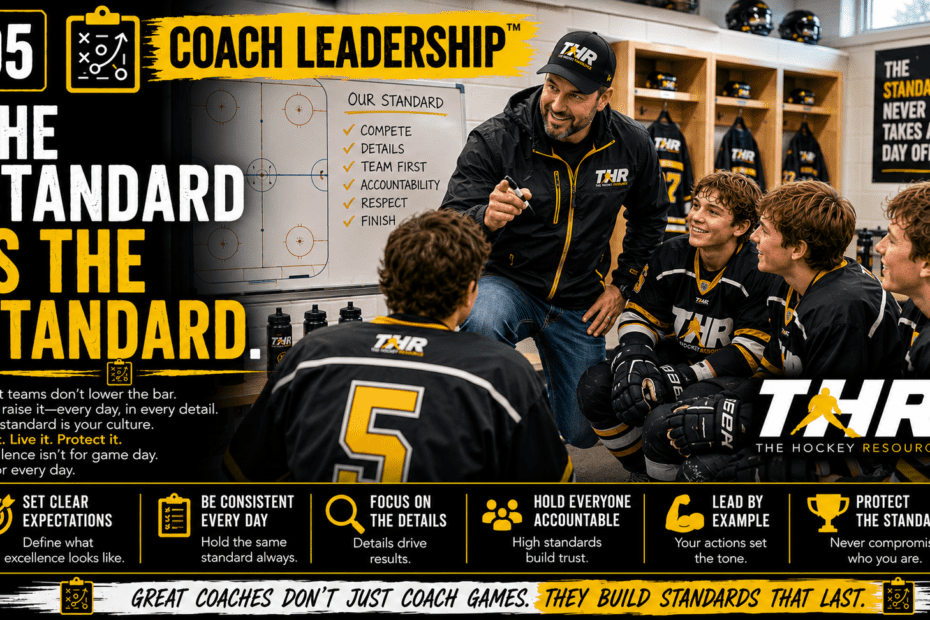
The standard is the standard.
Not sometimes.
Not when it is convenient.
Not only when things are going well.
The standard is the standard every day.
Players Watch for Consistency
Young athletes evaluate fairness constantly.
They observe how coaches respond to mistakes.
They pay attention to discipline.
They notice who receives opportunities.
They recognize when different rules apply.
Because of this awareness, leadership credibility depends heavily on consistency.
When players see standards applied fairly, trust grows.
When athletes see exceptions for certain individuals, confidence in leadership begins to decline.
As a result, consistency becomes a powerful leadership tool.
Standards Define Team Culture
Every team has a culture.
Some cultures develop intentionally.
Others develop accidentally.
Standards help determine which path an organization follows.
Expectations influence:
- Effort
- Attendance
- Preparation
- Communication
- Respect
- Accountability
- Teamwork
Without clear standards, confusion takes over.
Without consistent enforcement, culture weakens.
Therefore, coaches must define expectations early and reinforce them throughout the season.
Leadership Begins with Example
Players rarely follow standards that coaches ignore.
Leaders must demonstrate the behaviors they expect from others.
Preparation matters.
Professionalism matters.
Respect matters.
Accountability matters.
Whenever coaches model strong habits, athletes become more likely to adopt those habits themselves.
Consequently, leadership starts with personal example rather than verbal instruction.
The standard applies to everyone.
Including the coach.
Accountability Must Be Fair
Many teams struggle because accountability becomes selective.
Star players receive exceptions.
Veterans receive flexibility.
Certain individuals avoid consequences.
Meanwhile, others face strict enforcement.
Athletes recognize these differences immediately.
Trust suffers when fairness disappears.
Effective leaders understand that accountability is not punishment.
Accountability creates clarity.
Accountability reinforces expectations.
Accountability protects culture.
Because of that reality, standards must apply consistently across the entire roster.
Difficult Decisions Build Credibility
Leadership often requires uncomfortable decisions.
Sometimes a talented player must be challenged.
Occasionally a popular player needs correction.
Certain situations require difficult conversations.
Those moments test leadership.
Strong coaches prioritize culture over convenience.
Great leaders understand that protecting standards protects the entire team.
Although difficult decisions may create short-term discomfort, they often strengthen long-term trust.
Standards Create Confidence
Athletes perform better when expectations are clear.
Uncertainty creates anxiety.
Consistency creates confidence.
Players thrive when they understand:
- What is expected
- How success is measured
- What behaviors matter
- How decisions are made
As clarity increases, performance often improves.
Moreover, players become more accountable because standards are visible and understandable.
Leadership During Adversity
Maintaining standards is easy during winning streaks.
Challenges emerge during difficult periods.
Losing seasons.
Injuries.
Conflict.
Frustration.
Pressure.
Those situations reveal whether leadership principles are genuine.
Strong coaches maintain expectations regardless of circumstances.
Stable leadership creates stability throughout the team.
Because players know what to expect, they remain focused even when adversity appears.
Building Long-Term Respect
Respect cannot be demanded.
Influence cannot be assigned.
Leadership must be earned.
Consistency helps build that foundation.
Players respect coaches who treat people fairly.
Athletes trust leaders who follow through on commitments.
Parents appreciate transparency and integrity.
Over time, those qualities strengthen relationships throughout the organization.
The result is a healthier team culture and stronger leadership credibility.
The Legacy of High Standards
Championships create memories.
Standards create culture.
Wins matter.
Character matters more.
Years after a season ends, players often remember the expectations that shaped them.
They remember accountability.
They remember fairness.
They remember consistency.
Most importantly, they remember leaders who lived the standards they promoted.
The standard is not simply a rule.
The standard becomes the identity of the team.
Great coaches understand that leadership is measured by what they consistently allow, reinforce, and model.
The standard is the standard.
Every player.
Every practice.
Every game.
Every day.
PRESENTED BY: thehockeytournamentresource.com – mark@thehockeyresource.com
As always, thank you for being part of The Hockey Resource community.
You can find all the cards at thehockeytournamentresource.com
GUMROAD – ALL HOCKEY EBOOKS
https://thehockeyresource.gumroad.com/
CLICK LINK FOR AWESOME HOCKEY PRODUCTS – https://thehockeyresource.com/discount-hockey-products-amazon/
CLICK TO SEE MARK ON PODCAST – https://www.buzzsprout.com/1824112/episodes/13519482
Mark Hetherman
Executive Director
The Hockey Resource
mark@thehockeyresource.com
thehockeyresource.com
thehockeytournamentresource.com
As always, thank you for being part of The Hockey Resource Community.
AMAZON Hockey https://thehockeyresource.com/hockey-products-amazon/
NEW Tournament Search APP
https://play.google.com/store/apps/details?id=com.hockeyresource.hockeytournamentapp&hl=en_CA&pli=1
GUMROAD – eBooks
https://thehockeyresource.gumroad.com/
SEE My Interview with the Mental Health Academy
https://www.buzzsprout.com/1824112/episodes/13519482
https://thehockeytournamentresource.com/parent-questions-your-answers/
HOW WE REACHED THE HOCKEY ANSWER™
At The Hockey Tournament Resource™, we believe Hockey families, Players, Coaches and Officials deserve more than opinions. They deserve answers supported by research, experience and practical understanding of the game.
Every question begins with something Hockey people genuinely want to know.
OUR RESEARCH PROCESS
- WE FIND REAL QUESTIONS. We investigate what Hockey Players, Parents, Coaches and Officials are asking and searching for.
- WE SEARCH THE WORLD FOR ANSWERS. We examine relevant Hockey knowledge, coaching practices, available research and expert perspectives from around the world.
- WE COMPARE THE EVIDENCE. We look beyond individual opinions, consider different approaches and identify where the strongest available evidence points.
- WE APPLY REAL HOCKEY EXPERIENCE. We consider how the findings apply to actual Hockey situations, including different ages, skill levels and stages of development.
- WE DELIVER A PRACTICAL ANSWER. We explain what our research suggests, why it matters and what Hockey people can do with that information.
We recognize that not every Hockey question has one perfect answer. Age, ability, experience and individual circumstances can change what works best.
Our commitment is to provide thoughtful, practical answers while being clear about what the evidence supports and where uncertainty remains.
REAL CURRENT QUESTIONS. REAL CURRENT RESEARCH. REAL CURRENT ANSWERS.™
SEARCH THE WORLD FOR ANSWERS.™
The Hockey Tournament Resource™
LEARN WHEN IT FITS YOUR LIFE.™