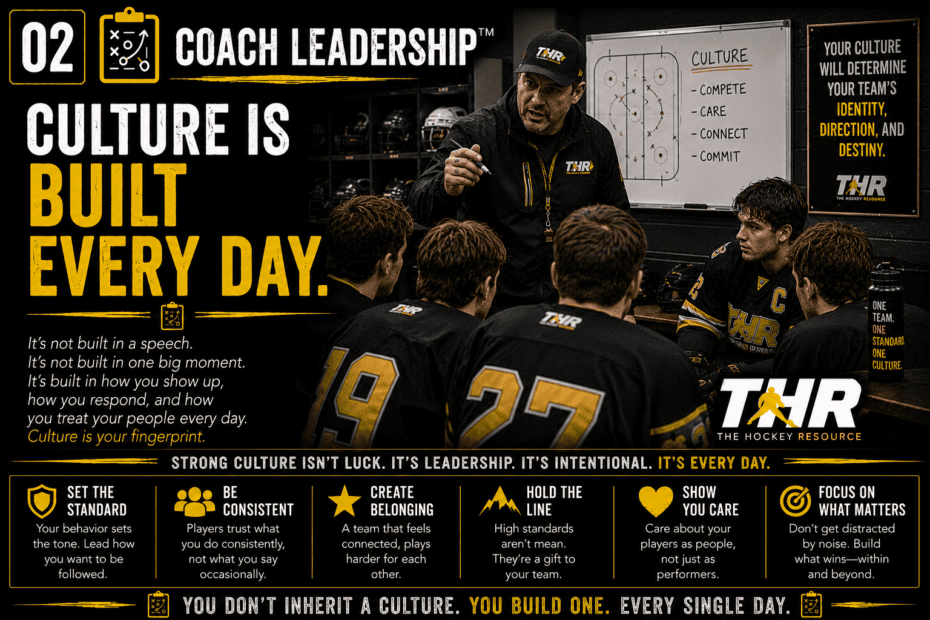
The Team Culture You Want Does Not Happen by Accident
Every hockey organization talks about culture.
Many coaches discuss culture.
Few leaders intentionally build it.
Culture is not a slogan hanging on a dressing room wall. It is not a mission statement buried inside a handbook. Instead, culture is created through daily actions, expectations, standards, and behaviors that players experience every time they enter the rink.
Because of this reality, coaches play a critical role in shaping the environment around their teams.
Strong cultures rarely appear overnight.
Successful cultures are built one practice, one conversation, and one decision at a time.
What Is Team Culture?
At its core, culture is simply “how things are done here.”
Players quickly learn what is acceptable.
Athletes discover what is rewarded.
Team members observe what leaders tolerate.
Consequently, culture becomes the invisible force that influences effort, accountability, communication, and relationships.
A positive culture encourages growth.
A negative culture creates division.
An inconsistent culture creates confusion.
Therefore, coaches must actively shape the environment they want their players to experience.
Every Action Sends a Message
Players are constantly watching.
They notice how coaches:
- Speak to officials
- Respond to mistakes
- Handle adversity
- Treat parents
- Communicate with staff
- Support struggling players
- Celebrate success
Each interaction teaches something.
Over time, those lessons become standards.
Eventually, those standards become culture.
As a result, leadership is often less about what coaches say and more about what coaches consistently do.
Standards Must Be Visible
Great cultures are built around clear expectations.
Without standards, players create their own.
Effective coaches establish expectations regarding:
- Effort
- Attendance
- Respect
- Accountability
- Communication
- Preparation
- Teamwork
Once standards are established, leaders must model them consistently.
Nothing damages culture faster than selective accountability.
Players immediately recognize when different rules apply to different individuals.
Trust disappears when standards become negotiable.
Accountability Creates Growth
Accountability is often misunderstood.
Many people associate accountability with punishment.
Strong leaders view accountability differently.
Instead of focusing on consequences, great coaches focus on responsibility.
Players learn:
- Own mistakes.
- Accept feedback.
- Learn from failure.
- Improve daily.
- Support teammates.
Consequently, accountability becomes a pathway to development rather than a source of fear.
Teams that embrace accountability often experience greater trust and stronger performance.
Trust Is the Foundation
Without trust, culture cannot survive.
Athletes must trust that coaches care about their development.
Parents must trust that decisions are fair.
Assistant coaches must trust leadership.
Players must trust one another.
Building trust requires
consistency.
honesty.
transparency.
Most importantly, trust requires time.
Once trust exists, communication improves and relationships strengthen.
Culture During Difficult Times
Winning often hides cultural weaknesses.
Adversity exposes them.
During losing streaks, injuries, roster challenges, or difficult seasons, players look to leadership for direction.
Positive cultures remain connected during difficult periods.
Healthy teams continue supporting one another.
Strong leaders maintain composure.
Because of that stability, players develop resilience and confidence.
Challenges become opportunities for growth rather than reasons for division.
Developing People Through Culture
Great coaches understand that culture extends beyond hockey.
Life lessons emerge from everyday team experiences.
Players learn:
- Respect
- Responsibility
- Leadership
- Communication
- Resilience
- Commitment
Years later, athletes may forget scores and standings.
However, they often remember how a team made them feel.
That emotional experience becomes part of a coach’s legacy.
Small Moments Matter Most
Many coaches focus on major events.
Championship games attract attention.
Tournament weekends generate excitement.
Yet culture is usually shaped during ordinary moments.
A conversation after practice.
A response to a mistake.
An encouraging word.
A difficult decision.
A consistent standard.
Together, those moments define the player experience.
The Legacy of Culture
Every team has a culture.
The only question is whether that culture develops intentionally or accidentally.
Successful coaches understand that leadership is a daily responsibility.
Positive environments do not happen by chance.
Strong cultures are built through consistent actions, meaningful relationships, and unwavering standards.
Every practice matters.
Every conversation matters.
Every decision matters.
Culture is built every day.
The best coaches make sure they are building the right one.
PRESENTED BY: thehockeyresource.com and thehockeytournamentresource.com – mark@thehockeyresource.com
As always, thank you for being part of The Hockey Resource community.
You can find all the cards at thehockeytournamentresource.com
GUMROAD – ALL HOCKEY EBOOKS
https://thehockeyresource.gumroad.com/
CLICK LINK FOR AWESOME HOCKEY PRODUCTS – https://thehockeyresource.com/discount-hockey-products-amazon/
CLICK TO SEE MARK ON PODCAST – https://www.buzzsprout.com/1824112/episodes/13519482
Mark Hetherman
Executive Director
The Hockey Resource
mark@thehockeyresource.com
thehockeyresource.com
thehockeytournamentresource.com