


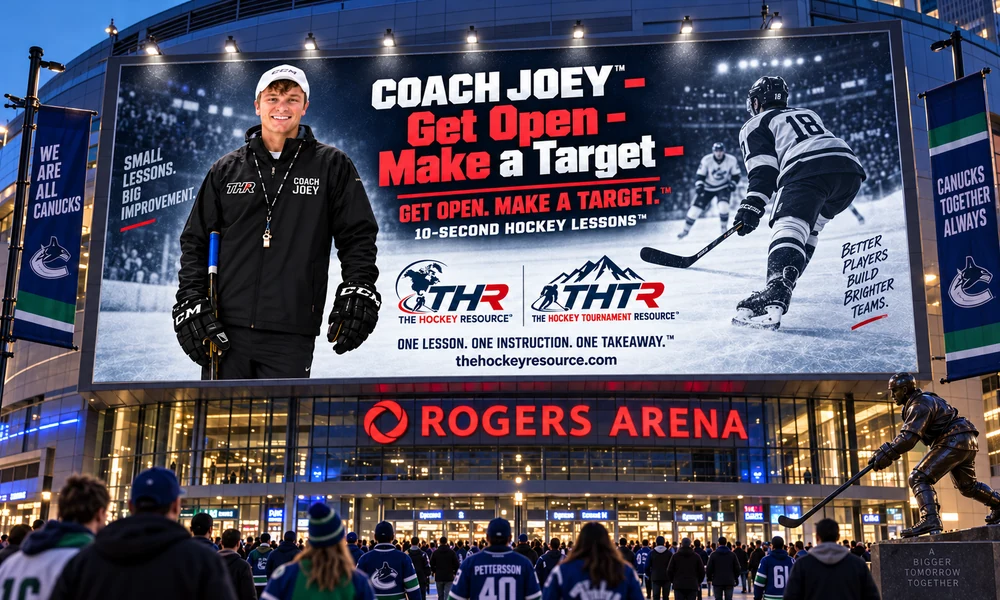
Get Open. Make a Target.™
COACH JOEY™ — AGE-APPROPRIATE LESSONS
U5-U7 + U8-U10 — Get Open and Show a Target
Move into open ice and put your stick on the ice so your teammate can see where to pass.
U11-U14 — Create a Passing Lane
Change speed or direction to separate from a defender, then present a target where the passing lane is actually open.
U15-U18 + Junior — Time Your Support
Use timing, spacing, and deception so you arrive as an option when the puck carrier needs you. Your movement can also pull a defender away and create space for someone else.
Coach Joey™ 10-Second Hockey Lessons™
Presented by The Hockey Resource™
Getting open is only part of receiving a good pass.
A Player also needs to help the teammate who has the puck.
One of the simplest ways to do that is to make a target with your stick.
Get Open First
Before your teammate can pass you the puck, you need to create space between yourself and the defender.
Don’t simply stand still and wait for the puck.
Move into open ice.
Change your speed.
Change direction when necessary.
Find an available passing lane.
The goal is simple:
Make yourself easier to find and easier to pass to.
Make a Target
Once you get open, show your teammate where you want the puck.
Put your stick on the ice and present the blade as a target.
This gives the passer something specific to aim for.
Instead of thinking:
“Pass it somewhere near me.”
the Player with the puck can see:
“That’s where my teammate wants the puck.”
It’s a small detail that can make passing easier for both Players.
Your Stick Communicates
Hockey Players communicate in many ways.
They
talk.
point.
make eye contact.
also communicate with their sticks.
A stick presented in a good receiving position tells your teammate:
I’m ready.
It can also indicate where you want the pass delivered.
That becomes increasingly important as Players get older and the game becomes faster.
Don’t Wait Until the Puck Arrives
Receiving a pass starts before the puck leaves your teammate’s stick.
A Player should be:
Scanning the ice.
Know where teammates and opponents are.
Moving into space.
Create separation and a passing lane.
Preparing the stick.
Give the passer a clear target.
Ready to receive.
Prepare for what you will do next before the puck arrives.
These habits help make passing and puck movement more efficient.
For Young Hockey Players
At younger ages, Coaches don’t need to turn this into a lecture worthy of a university seminar.
Give the Player one simple instruction:
GET OPEN. MAKE A TARGET.™
Then reinforce it during practices and games.
When a Player moves into open ice and presents the stick properly, recognize the behavior even if the pass doesn’t arrive.
We’re developing the habit, not merely celebrating the result.
For Coaches
Build the concept into passing drills.
Instead of only measuring whether two Players successfully complete a pass, watch what happens before the pass.
Did the receiving Player move?
Did they create a passing lane?
Was their stick available?
Did they provide a useful target?
Did they prepare for the next play?
The quality of a pass depends partly on the Player making it, but the receiving Player has responsibilities too.
For Hockey Parents
This is also a useful reminder about what to watch during games.
A Player doesn’t need the puck to be playing well.
Watch what your child does without the puck.
Are they
finding open ice?
supporting teammates?
creating passing options?
making themselves available?
Those small habits can eventually become very important parts of a Player’s game.
Coach Joey’s 10-Second Lesson™
Get open for your teammate.
Put your stick on the ice.
Give the passer a target.
ONE LESSON. ONE INSTRUCTION. ONE TAKEAWAY.™
HOCKEY moves quickly. Players have very little time to see the ice, make decisions, and react to pressure. Because of that, good communication can make
As always, thank you for being part of The Hockey Resource Community.
AMAZON Hockey https://thehockeyresource.com/hockey-products-amazon/
NEW Tournament Search APP
https://play.google.com/store/apps/details?id=com.hockeyresource.hockeytournamentapp&hl=en_CA&pli=1
GUMROAD – eBooks
https://thehockeyresource.gumroad.com/
SEE My Interview with the Mental Health Academy
https://www.buzzsprout.com/1824112/episodes/13519482
https://thehockeytournamentresource.com/parent-questions-your-answers/
HOW WE REACHED THE HOCKEY ANSWER™
At The Hockey Tournament Resource™, we believe Hockey families, Players, Coaches and Officials deserve more than opinions. They deserve answers supported by research, experience and practical understanding of the game.
Every question begins with something Hockey people genuinely want to know.
OUR RESEARCH PROCESS
- WE FIND REAL QUESTIONS. We investigate what Hockey Players, Parents, Coaches and Officials are asking and searching for.
- WE SEARCH THE WORLD FOR ANSWERS. We examine relevant Hockey knowledge, coaching practices, available research and expert perspectives from around the world.
- WE COMPARE THE EVIDENCE. We look beyond individual opinions, consider different approaches and identify where the strongest available evidence points.
- WE APPLY REAL HOCKEY EXPERIENCE. We consider how the findings apply to actual Hockey situations, including different ages, skill levels and stages of development.
- WE DELIVER A PRACTICAL ANSWER. We explain what our research suggests, why it matters and what Hockey people can do with that information.
We recognize that not every Hockey question has one perfect answer. Age, ability, experience and individual circumstances can change what works best.
Our commitment is to provide thoughtful, practical answers while being clear about what the evidence supports and where uncertainty remains.
REAL CURRENT QUESTIONS. REAL CURRENT RESEARCH. REAL CURRENT ANSWERS.™
SEARCH THE WORLD FOR ANSWERS.™
The Hockey Tournament Resource™
LEARN WHEN IT FITS YOUR LIFE.™