

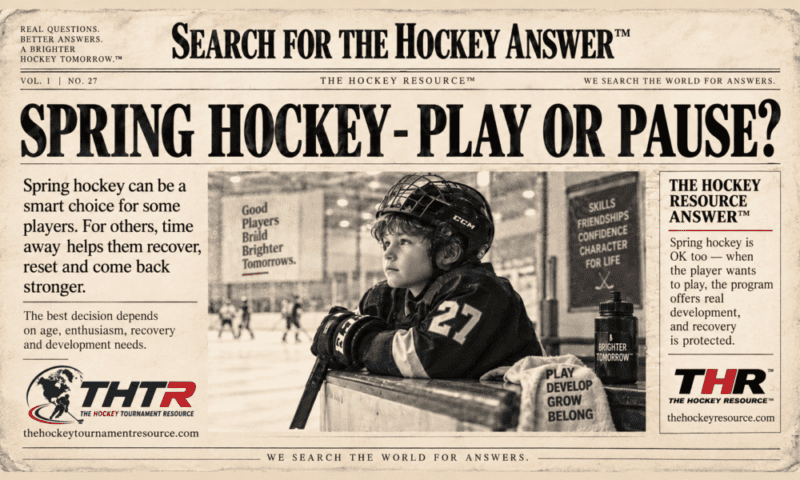
SEARCH FOR THE HOCKEY ANSWER™ – SPRING HOCKEY
HOCKEY PARENT INTELLIGENCE™ | QUESTION 5 – SPRING HOCKEY
Every spring, Hockey parents face a familiar decision.
The winter season has ended. The equipment is still drying, families are recovering from months of practices and tournaments, and invitations are already arriving for spring Hockey Teams, camps and development programs.
Some parents are eager to register.
Others wonder whether their child would benefit from time away from the rink.
Then comes the question that influences so many Hockey decisions:
If my child takes the spring off, will other Players get ahead?
It is a reasonable concern, especially for families whose children hope to play at higher competitive levels.
But the decision deserves more consideration than simply following what other families are doing.
Should your child play spring Hockey or take time off?
THE HOCKEY RESOURCE ANSWER™
Your child should play spring Hockey when the experience offers meaningful development, the Player wants to participate and the additional commitment allows adequate recovery. When those conditions are absent, taking time off may be the better development decision.
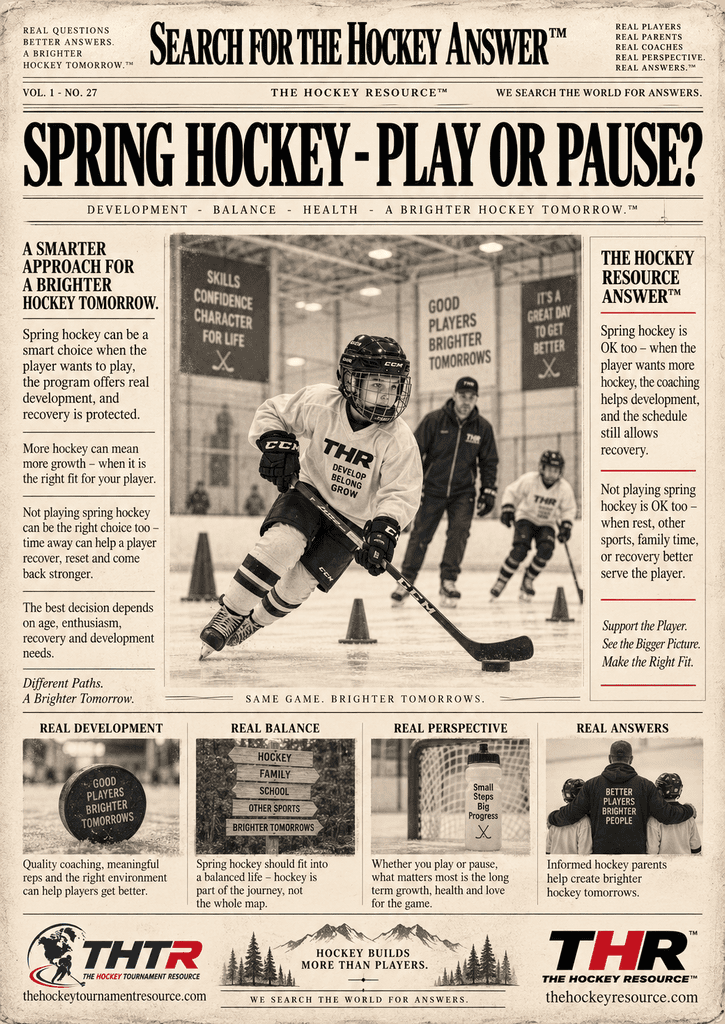
More Hockey does not automatically produce a better Hockey Player.
Neither does taking time away from organized Hockey guarantee improvement.
The best choice depends on the individual Player.
A young Player learning fundamental skating skills has different development needs from a U16 AAA Player preparing for Junior Hockey.
Similarly, a motivated Player who enjoys additional practices may benefit from a carefully selected spring program. Another Player, physically and mentally tired after a demanding winter season, may benefit more from recovery and other activities.
The objective should be better development, not simply more participation.
WHY DO PARENTS BELIEVE SPRING HOCKEY IS NECESSARY?
Hockey is a competitive environment.
As Players move through age groups, families begin comparing skill levels, Team selections, development opportunities and future pathways.
Parents naturally want to provide every reasonable opportunity for their children.
However, that ambition can create pressure.
Spring Hockey invitations may arrive with promises of improved skills, stronger competition, increased visibility and preparation for next season’s tryouts.
Some programs deliver meaningful benefits.
Others primarily provide additional games without enough purposeful instruction.
Parents should recognize an important distinction:
Playing more Hockey and learning more Hockey are not necessarily the same thing.
A Player can participate in numerous tournaments without significantly improving skating technique, puck control, positioning or decision-making.
Meanwhile, another Player may make meaningful improvements through fewer, better-designed training sessions.
That is why the quality of the opportunity matters more than the number of games advertised.
CAN TAKING TIME OFF HELP HOCKEY DEVELOPMENT?
Yes. Time away from organized Hockey can support several important aspects of long-term development.
Physical Recovery
Hockey places repeated demands on the body.
Skating, stopping, accelerating, changing direction and competing in games all require physical effort.
Young Players also experience growth and physical maturation at different rates.
Without appropriate recovery, additional training can contribute to excessive fatigue and overuse problems.
Taking time away from demanding Hockey schedules allows the body an opportunity to recover.
That does not require complete inactivity.
Mental Recovery
Hockey also creates emotional and psychological demands.
Players experience competition, evaluations, mistakes, Team expectations and the pressure of trying to improve.
Some enjoy these challenges and remain enthusiastic throughout the season.
Others begin to feel exhausted by the schedule.
A break may help restore motivation and enjoyment.
Developing Different Athletic Skills
Children can improve athletic abilities through many activities outside Hockey.
Tennis, soccer, swimming, baseball, cycling and recreational play expose Players to different movements and challenges.
Balance, coordination, agility and general physical fitness can develop through participation in multiple activities.
These experiences do not replace Hockey-specific skills, but they can contribute to broader athletic development.
Renewing Interest in Hockey
Sometimes a break helps a Player rediscover enthusiasm.
After several weeks away from practices and games, a child may begin asking when Hockey starts again.
That renewed interest can be valuable.
Long-term improvement requires repeated practice, but sustained motivation also matters.
SHOULD SPRING HOCKEY DECISIONS CHANGE WITH AGE?
Absolutely.
A development decision suitable for a six-year-old may be inappropriate for a seventeen-year-old.
U5–U7: IS SPRING HOCKEY NECESSARY?
THE HOCKEY RESOURCE RECOMMENDATION™
At U5–U7, the primary objective should be enjoyment, skating confidence and fundamental movement development.
Children do not need year-round competitive Hockey schedules to begin developing these skills.
Occasional spring skating can be useful when the child wants to participate and the environment is positive.
However, there is little reason to turn spring Hockey into another demanding competitive season.
Parents should prioritize enjoyment, free play and exposure to different physical activities.
Parent takeaway: At U5–U7, developing a love of Hockey matters more than accumulating games.
U8–U10: SHOULD PARENTS CHOOSE SKILLS OR TOURNAMENTS?
THE HOCKEY RESOURCE RECOMMENDATION™
Players in this age range are developing important skating, passing, shooting and puck-control foundations.
Additional instruction may be useful.
However, parents should distinguish between programs designed to teach skills and Teams organized primarily to compete in tournaments.
For a Player who needs to improve skating, a qualified skating Coach providing focused instruction may offer greater developmental value than another tournament schedule.
A short, well-designed program may be sufficient.
Parents should also protect meaningful opportunities for recovery and other activities.
Parent takeaway: Better instruction can be more valuable than additional games.
U11–U14: WILL TAKING SPRING OFF HURT MY CHILD’S AAA OPPORTUNITIES?
THE HOCKEY RESOURCE RECOMMENDATION™
This is an age range when competitive pressure often increases.
Players begin developing at different physical rates, and differences in size, strength and maturity may become more noticeable.
Parents may worry that skipping spring Hockey will place their child behind other AA or AAA Players.
However, participating in spring tournaments is not a universal requirement for reaching a higher competitive level.
What matters is whether the Player continues developing the skills and abilities needed to progress.
For some Players, targeted skating or puck-skill instruction may be beneficial.
Others may need greater attention to physical conditioning, confidence, decision-making or recovery.
Parents should begin by identifying the Player’s actual development needs.
Only then should they evaluate which program, if any, addresses those needs.
Parent takeaway: Choose the development program that addresses your child’s weaknesses, not the program everyone else is attending.
U15–U18: WHEN IS SPRING HOCKEY WORTH THE INVESTMENT?
THE HOCKEY RESOURCE RECOMMENDATION™
Older competitive Players may have more specific ambitions involving AAA, Junior Hockey, school Teams or recruitment opportunities.
Spring training, camps and selected showcases can provide meaningful opportunities.
However, parents should distinguish between legitimate development and promotional promises.
Before registering, determine who will provide instruction, what level of competition is involved, and whether the opportunity genuinely supports the Player’s goals.
For example, an older Player may benefit from a structured off-season development program focused on skating, strength or specific positional skills.
Another Player may need a period of recovery before beginning a new training cycle.
A tournament offering additional games without a clear development purpose may not justify the cost.
Parent takeaway: At U15–U18, every spring Hockey investment should have a specific purpose.
JUNIOR HOCKEY: SHOULD PLAYERS TRAIN THROUGH THE SPRING?
THE HOCKEY RESOURCE RECOMMENDATION™
Junior Players have different competitive objectives and physical demands.
Off-season planning may involve strength and conditioning, skating, technical instruction and preparation for future opportunities.
However, effective training requires appropriate recovery and an individualized plan.
Players should work with qualified Coaches and training professionals to identify priorities.
The goal is to prepare for the next competitive season, not simply extend the previous one.
Player takeaway: A productive off-season is measured by preparation and improvement, not the number of events attended.
DOES SPRING HOCKEY PROVIDE BETTER DEVELOPMENT THAN PLAYING OTHER SPORTS?
Not necessarily.
Spring Hockey provides opportunities to practise Hockey-specific skills.
Other sports can develop broader athletic abilities.
Neither choice automatically provides greater value.
A Player who needs technical skating instruction may benefit from a carefully selected Hockey program.
Another Player may gain more from improving general coordination, movement confidence and physical fitness through different activities.
Parents should also understand that participating in multiple sports does not eliminate the need for recovery.
An overloaded schedule remains an overloaded schedule, even when the activities involve different sports.
The objective is balanced development, not simply replacing one demanding schedule with another.
WHAT ABOUT GOALIES? SHOULD THEY PLAY SPRING HOCKEY?
Goalies deserve separate consideration.
Goalie development involves specialized skating, positioning, movement, puck tracking, rebound control and decision-making.
Additional games may provide experience, but they do not automatically address technical weaknesses.
For a young Goalie, a small number of sessions with a qualified Goalie Coach may offer greater value than participating in several spring tournaments without specialized instruction.
Older competitive Goalies may benefit from carefully planned technical training and appropriate game experience.
However, recovery remains important, particularly after a season involving substantial physical and mental demands.
THE HOCKEY RESOURCE GOALIE PERSPECTIVE™
Parents should evaluate the qualifications of the Goalie Coach and the specific skills being taught.
More shots faced do not automatically mean better Goalie development.
FIVE WARNING SIGNS YOUR CHILD MAY NEED A BREAK
Parents should pay attention to changes in enthusiasm, energy and overall well-being.
1. Your Child No Longer Looks Forward to Hockey
A Player who repeatedly expresses reluctance to attend practices or games may need a conversation about enjoyment, pressure or fatigue.
2. Physical Fatigue Continues
Persistent tiredness, poor recovery or declining energy should not be dismissed as a normal consequence of commitment.
3. Pain or Injuries Keep Returning
Recurring pain or discomfort may indicate that the Player needs medical assessment and changes to training demands.
4. Hockey Is Creating More Stress Than Enjoyment
Competition can be challenging, but consistently negative experiences deserve attention.
5. Your Child Has Little Time for Anything Else
When Hockey crowds out friendships, school responsibilities, rest and other interests, parents should reconsider the schedule.
These warning signs are not automatic evidence of burnout. Persistent symptoms warrant appropriate professional assessment.
SEVEN QUESTIONS TO ASK BEFORE PAYING FOR SPRING HOCKEY
Before registering, parents should answer these questions honestly.
1. Does my child genuinely want to play?
The Player’s interest matters. Participation should not be driven entirely by parental expectations.
2. What specific skill will improve?
A program should offer more than vague promises of development.
3. Who will provide the coaching?
Qualified instruction may matter more than additional game opportunities.
4. How much Hockey is involved?
Consider practices, games, tournaments, travel and the total time commitment.
5. Has my child recovered from the winter season?
Physical and mental recovery should be part of the decision.
6. What other opportunities will my child miss?
Consider family activities, friendships, other sports and personal interests.
7. Is this the best use of our Hockey development budget?
Compare the cost and likely benefits with other available options.
Parents should be able to explain why a particular spring program is worthwhile for their child.
If they cannot identify a meaningful benefit, they should reconsider the investment.
THE HOCKEY RESOURCE PERSPECTIVE™
WHY DO WE BELIEVE MORE HOCKEY ALWAYS MEANS BETTER DEVELOPMENT?
Hockey families invest considerable time, energy and money helping their children improve.
That commitment deserves respect.
But there is an important difference between being committed to development and believing that every available Hockey opportunity must be purchased.
A Player does not become better simply because another tournament appears on the schedule.
Development requires learning, practice, appropriate competition, recovery and motivation.
More Hockey may produce more opportunities to improve. It does not guarantee more improvement.
Consider the financial commitment as well.
Spring Hockey can involve registration fees, tournament costs, travel, accommodations and meals.
For some families, that represents a significant additional expense.
Before spending that money, parents should ask whether the opportunity provides meaningful value.
The best developmental choice may be a short skating program.
It may be individual instruction.
It could be participation in another sport.
Sometimes, the answer is simply allowing the Player to enjoy a break.
The Hockey Resource™ believes parents should make these decisions based on the individual Player’s needs rather than pressure, promises or the choices of other families.
Hockey development should be measured over years, not one spring season.
THE HOCKEY RESOURCE TAKEAWAY™
Spring Hockey can provide valuable opportunities when a program offers qualified instruction, a clear development purpose and an appropriate schedule.
Taking time away from organized Hockey can also support physical recovery, mental freshness and broader athletic development.
The right decision depends on the individual Player.
Parents should consider age, enjoyment, recovery, coaching quality, development needs and family circumstances.
Above all, avoid making the decision simply because another Player has registered.
MORE HOCKEY IS NOT ALWAYS BETTER HOCKEY.™
THE BEST DEVELOPMENT DECISION IS THE ONE THAT HELPS YOUR CHILD, NOT THE ONE EVERYONE ELSE IS MAKING.
THREE WAYS TO LEARN™
ONE QUESTION. ONE RESEARCHED ANSWER. THREE WAYS TO LEARN.
READ IT. TAKE THE QUIZ. LISTEN TO THE AUDIO.
LEARN WHEN IT FITS YOUR LIFE.™
Use the complete article to understand the development decision, take the interactive Hockey Parent quiz to test your judgment, or listen to the short audio lesson.
HOW WE REACHED THE HOCKEY ANSWER™
Our research can reach across Hockey organizations, development programs, current studies, expert guidance, public discussion and real-world Hockey experience to find the strongest information available. We compare the evidence, challenge the obvious answer, consider how age, level, position and circumstances may change it, and then combine everything into one clear Hockey answer designed to help you make a better decision.
As always, thank you for being part of The Hockey Resource Community.
AMAZON Hockey https://thehockeyresource.com/hockey-products-amazon/
NEW Tournament Search APP
https://play.google.com/store/apps/details?id=com.hockeyresource.hockeytournamentapp&hl=en_CA&pli=1
NEW!!! The Hockey Moments Cards
GUMROAD – eBooks
https://thehockeyresource.gumroad.com
SEE My Interview with the Mental Health Academy