

A Hockey Parent watches another family sign up for spring Hockey.
Then another Hockey family announces a summer Team.
Someone else has booked private skating lessons.
Another Player has a shooting Coach.
A Parent on social media says their ten-year-old is already training “like an elite athlete.”
Suddenly, letting your son play baseball, soccer, lacrosse or simply take a few weeks away from the rink can feel less like balance and more like falling behind.
That fear is real.
And it leads to one of the most important development questions in Minor Hockey:
Should my son specialize in Hockey or play other sports?
The easy answer would be:
Play other sports.
But that is not enough.
Parents deserve to understand why, when the answer changes, when more Hockey is genuinely valuable, and when pressure to specialize may work against long-term development.
The answer for a six-year-old should not be the same as the answer for a sixteen-year-old trying to make Junior Hockey.
That is where the real Hockey decision begins.
THE HOCKEY RESOURCE ANSWER™
For most boys, early specialization in Hockey is unnecessary.
At younger ages, the better development path is usually to combine Hockey with a wide variety of athletic experiences.
As the Player grows older, becomes more skilled, develops clearer goals and begins competing for higher-level opportunities, Hockey-specific training can increase.
Eventually, for some U15, U16, U18 and Junior Players, Hockey may appropriately become the primary sport.
But specialization should be a progression based on age, development, ability and motivation.
It should not begin because another nine-year-old is skating in July.
The goal is not to create the Player with the busiest Hockey calendar.
The goal is to create the Player with the strongest long-term development.
WHAT DOES HOCKEY SPECIALIZATION ACTUALLY MEAN?
Playing a lot of Hockey does not automatically mean a Player is specialized.
A child might play on a winter Team, attend a short skills clinic in spring and shoot pucks at home during the summer.
That can still leave room for:
- other sports;
- free play;
- family activities;
- recovery;
- unstructured movement;
- time completely away from organized Hockey.
Specialization becomes more significant when one sport dominates the calendar and other athletic experiences are increasingly eliminated.
A highly specialized young Player may:
- participate in Hockey most of the year;
- stop playing other organized sports;
- train almost exclusively for Hockey;
- play on multiple Hockey Teams or programs;
- have little meaningful off-season;
- experience increasing pressure to maintain the schedule.
That does not mean specialization is automatically harmful.
It means the Parent should understand what the Player is giving up in exchange for additional Hockey.
Every development decision has a cost.
More Hockey costs time.
It costs recovery.
It may cost another sport.
It may cost family time.
Eventually, it can cost enthusiasm.
The important question is whether the additional Hockey produces enough development value to justify that cost.
WHY PLAY OTHER SPORTS IF HOCKEY IS THE SPORT HE LOVES?
Because Hockey does not require only Hockey skills.
A strong Hockey Player is also an athlete.
He needs:
- balance;
- coordination;
- acceleration;
- deceleration;
- reaction;
- strength;
- body control;
- spatial awareness;
- competitive instincts;
- decision-making;
- confidence.
Different sports challenge those qualities in different ways.
The point is not that soccer automatically improves a Hockey shot.
The point is that athletic development can occur somewhere besides a rink.
SOCCER
Soccer requires constant movement.
Players accelerate, stop, change direction, create space and react to teammates and opponents.
A Hockey Player can develop:
- foot speed;
- endurance;
- spatial awareness;
- support positioning;
- transition;
- deception;
- movement without the puck.
The surfaces and techniques are different.
The athletic problem-solving is valuable.
BASKETBALL
Basketball can challenge a young athlete to:
- accelerate rapidly;
- decelerate under control;
- move laterally;
- defend space;
- change direction;
- transition instantly from offence to defence;
- create passing lanes;
- read several Players at once.
Those qualities are useful in Hockey because athletic intelligence does not belong exclusively to one sport.
BASEBALL
Baseball provides different physical and mental demands:
- visual tracking;
- hand-eye coordination;
- throwing mechanics;
- rotational movement;
- explosive actions;
- patience;
- individual performance under pressure.
A baseball swing does not teach a slap shot.
But learning to coordinate vision, timing and full-body movement is still athletic development.
LACROSSE
Lacrosse has obvious crossover value for Hockey Players.
It can develop:
- stick awareness;
- deception;
- hand-eye coordination;
- passing;
- finding open space;
- offensive creativity;
- movement away from the ball.
The sports are different.
But Players learn to manipulate defenders and create opportunities in ways that may broaden their Hockey instincts.
TENNIS
Tennis develops:
- reaction;
- balance;
- acceleration;
- recovery;
- anticipation;
- hand-eye coordination;
- individual decision-making.
There is nowhere to hide.
The athlete decides, moves, reacts and immediately discovers whether the decision worked.
That is valuable athletic learning.
WHY NOT JUST DEVELOP ALL OF THOSE SKILLS THROUGH HOCKEY?
Because Hockey is highly specific.
Skates change movement.
Ice changes friction.
A stick changes hand position.
Equipment changes body mechanics.
The game creates unique demands.
Those demands are exactly why Hockey-specific practice matters.
But a young body and brain can benefit from solving other movement problems too.
At younger ages, the goal is not simply to create a better Hockey specialist.
It is to create:
a better mover;
a better learner;
a more adaptable athlete.
WILL MY SON FALL BEHIND IF HE TAKES TIME AWAY FROM HOCKEY?
This is the Parent fear behind almost every specialization discussion.
And the answer requires some honesty.
He might look behind temporarily.
Imagine two ten-year-old Players of similar ability.
Player A skates three times per week all summer.
Player B plays soccer, swims, rides his bike and takes eight weeks away from structured Hockey.
When tryouts begin, Player A may initially:
- handle the puck more comfortably;
- feel sharper on his edges;
- have better Hockey timing;
- appear more game-ready.
Player B may look rusty.
That does not automatically mean Player B lost long-term development.
Rust is temporary.
Athletic development may not be.
A Parent needs to separate:
WHO LOOKS BETTER THIS WEEK?
from:
WHO IS DEVELOPING BEST OVER THE NEXT FIVE YEARS?
Those are different questions.
Minor Hockey often measures long-term development with short-term snapshots.
That can lead Parents toward the wrong decision.
WHY MORE HOCKEY DOES NOT AUTOMATICALLY MEAN MORE DEVELOPMENT
Playing Hockey and developing Hockey ability are related.
They are not identical.
A Player can play 60 games and repeat the same weakness 60 times.
He can skate in another tournament without improving his skating mechanics.
He can take another 500 game shots without correcting a poor release.
He can spend another weekend chasing the puck without improving his decision-making.
So before adding more Hockey, ask:
What are we actually trying to improve?
If skating is the weakness, targeted skating instruction may be more valuable than another tournament.
If shooting mechanics are weak, deliberate shooting practice may outperform another twelve games.
If the Player lacks strength or coordination, the answer may not even be more ice.
Development should be built around the Player’s needs.
Not around the number of programs available.
REPETITION MATTERS, BUT QUALITY MATTERS TOO
Hockey Players need repetitions.
There is no shortcut around that.
Players improve skating by skating.
They improve shooting by shooting.
They improve puck control by handling pucks.
But repetitions only become development when they are useful repetitions.
Twenty poor repetitions do not automatically beat ten high-quality repetitions.
Another game is not automatically better than a well-designed practice.
Parents should begin asking:
- Who is teaching?
- What is being taught?
- Is feedback being provided?
- Is the Player correcting mistakes?
- Is the training age-appropriate?
- Is the Player engaged?
- Does the program address an actual development need?
MORE HOCKEY is a volume measurement.
BETTER HOCKEY DEVELOPMENT is a quality measurement.
They should not be confused.
THE RECOVERY PROBLEM
Training stresses the body.
That is not bad.
It is how physical improvement begins.
But development does not occur only during the training session.
The body also needs time to recover and adapt.
When repeated training, games and tournaments pile up without enough recovery, the Player can accumulate fatigue.
That can affect:
- performance;
- concentration;
- mood;
- motivation;
- sleep;
- physical readiness;
- injury risk.
Rest is therefore not something that interrupts development.
REST IS PART OF DEVELOPMENT.
WHAT DOES THE INJURY RESEARCH ACTUALLY SAY?
This topic is often oversimplified.
We should not tell Parents:
“Specialization causes injuries.”
The science is more complicated.
Injury risk is influenced by many factors:
- age;
- growth;
- training load;
- recovery;
- strength;
- previous injury;
- sport;
- competition level;
- movement quality;
- sleep;
- physical maturity.
But research has repeatedly found an association between greater youth sport specialization and increased overuse injury risk.
That does not mean every specialized Player will be injured.
It also does not mean every multi-sport athlete will remain injury-free.
The reasonable conclusion is:
DO NOT ASSUME EARLY YEAR-ROUND SPECIALIZATION IS NECESSARY OR RISK-FREE.
That is a much stronger and more accurate development message.
WHAT ABOUT BURNOUT?
Physical injury is easier to see.
Burnout can develop more quietly.
A child may still attend practice.
He may still play well.
He may still make the Team.
But enjoyment can slowly disappear.
Watch for changes.
Does he still ask to go to the rink?
Does he practise because he wants to?
Does he talk excitedly about Hockey?
Does every session now require pushing?
Is he increasingly irritable around Hockey?
Does he seem relieved when practices are cancelled?
Has Hockey become an obligation?
The goal should not merely be to keep the Player participating.
The goal should be to protect the desire to participate.
A young athlete who loves Hockey at ten but hates it at fourteen has not necessarily been successfully developed just because he accumulated thousands of ice hours.
WHY TAKING TIME AWAY CAN HELP
Time away gives the body a break.
It can also reset motivation.
There can be developmental value in:
finishing a season;
doing something different;
missing Hockey;
wanting to return.
That cycle can protect enthusiasm.
If a Player never gets away from the game, Hockey can become normal background noise rather than something he is excited to play.
More exposure does not always create more passion.
Sometimes absence helps preserve it.
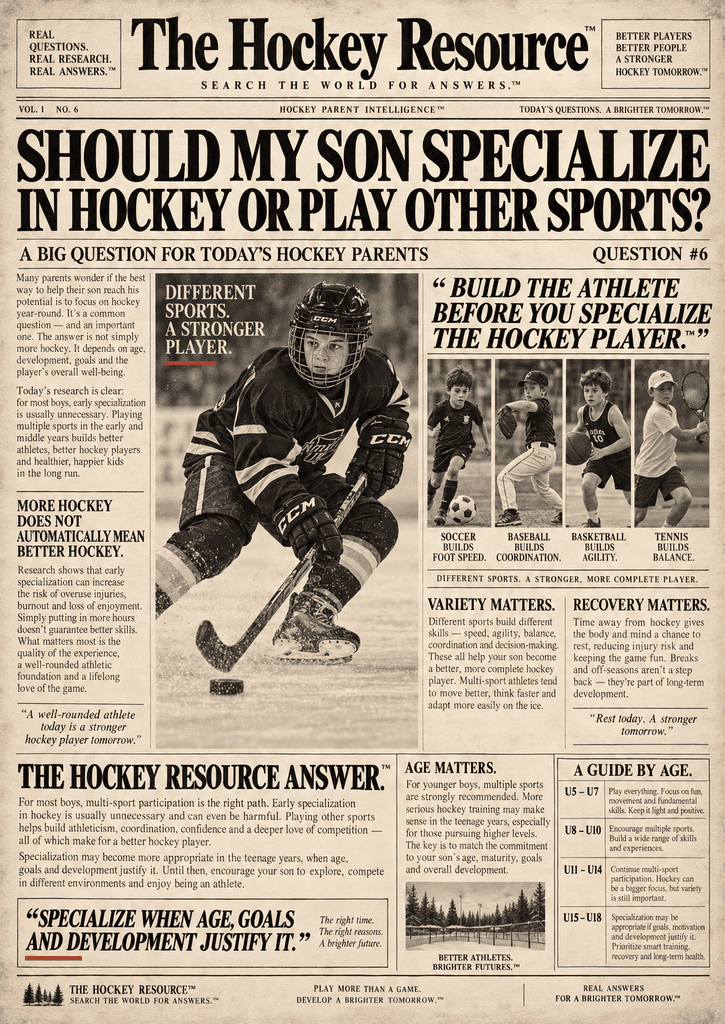
U5–U7: BUILD THE ATHLETE BEFORE THE SPECIALIST
At U5–U7, the answer should be straightforward.
Do not build the child’s life around Hockey specialization.
These are foundational movement years.
A child should be learning to:
- run;
- jump;
- throw;
- catch;
- kick;
- balance;
- twist;
- climb;
- stop;
- start;
- change direction;
- react.
Hockey absolutely belongs in that development.
But Hockey should not have to provide all of it.
THE HOCKEY RESOURCE ANSWER™ FOR U5–U7
Let him play Hockey.
Let him learn to skate.
Let him become comfortable with a stick and puck.
But let him experience other sports, playgrounds, bikes, swimming, snow, fields and movement.
At six years old, athletic curiosity is more important than athletic specialization.
WHY THIS MATTERS
A young Player is still learning how to control his body.
Different activities expose him to different movement challenges.
That creates a broader physical foundation.
The objective is not to build the world’s most polished seven-year-old Hockey Player.
The objective is to give the child the movement foundation from which later Hockey skills can grow.
15-SECOND VIDEO — U5–U7
“Your six-year-old doesn’t need a twelve-month Hockey résumé. He needs to run, jump, throw, catch, skate and play. Build the athlete first. There is plenty of time to specialize later.”
U8–U10: THIS IS WHERE PARENT FEAR OF FALLING BEHIND GROWS
By U9 and U10, skill differences become easier to see.
Some Players skate faster.
Some control the puck better.
Some score more.
Some make higher-level Teams.
Parents start comparing.
And suddenly off-season decisions feel more important.
This is exactly where families can begin mistaking volume for development.
THE HOCKEY RESOURCE ANSWER™ FOR U8–U10
Hockey can be important without becoming the only sport.
A Player can:
- complete his regular Hockey season;
- choose one useful spring program;
- attend a focused skating or skills camp;
- play baseball or soccer;
- swim;
- bike;
- take genuine time off.
The Player does not need every available Hockey opportunity.
He needs the right opportunities.
HOW TO DECIDE ON EXTRA HOCKEY
Ask three questions.
What does he need to improve?
If he needs skating help, choose skating development.
Does he want to do it?
A Player’s enthusiasm matters.
What are we giving up?
If another Hockey program eliminates all recovery and every other sport, the cost is larger than the registration fee.
15-SECOND VIDEO — U8–U10
“Don’t measure your ten-year-old’s development by who looks sharpest at the first September practice. Hockey rust disappears. Athletic development stays. Think in years, not weeks.”
U11–U14: NOW DEVELOPMENT SHOULD BECOME MORE INDIVIDUAL
This is where a blanket answer becomes less useful.
Some U12 Players are recreational.
Some are highly competitive.
Some are physically mature.
Others are late developers.
Some dream about Junior Hockey.
Some simply love playing with their friends.
The development plan should begin reflecting those differences.
THE HOCKEY RESOURCE ANSWER™ FOR U11–U14
Hockey-specific training can increase.
But every extra program should have a reason.
This is the age to ask:
- What are the Player’s strongest skills?
- What are his weakest skills?
- What level is he realistically pursuing?
- Is he motivated to train?
- Is he physically recovering?
- Does he still enjoy other sports?
- Is another Hockey program solving an actual problem?
EXAMPLE: STRONG HANDS, WEAK SKATING
The Parent could purchase another tournament package.
But if skating is limiting the Player, targeted skating instruction may have far greater value.
EXAMPLE: STRONG SKATER, WEAK SHOT
Another 20 games may provide more shots.
But carefully coached shooting repetitions could fix the technical problem faster.
EXAMPLE: GOOD HOCKEY PLAYER WHO LOVES SOCCER
Does he automatically need to quit soccer because Hockey is becoming serious?
Not necessarily.
If schedules remain manageable and soccer continues contributing to athleticism and enjoyment, there can still be value in doing both.
The important question is not:
WHEN DO WE ELIMINATE OTHER SPORTS?
It is:
WHEN DOES THE PLAYER’S HOCKEY DEVELOPMENT GENUINELY REQUIRE MORE SPECIALIZATION?
15-SECOND VIDEO — U11–U14
“At twelve or thirteen, extra Hockey can make sense. But give every extra session a purpose. Skating problem? Work on skating. Weak shot? Work on shooting. Don’t buy more Hockey just because more Hockey is available.”
U15–U18: SPECIALIZATION MAY NOW BE THE RIGHT CHOICE
By the mid-to-late teenage years, the answer can change significantly.
A Player pursuing:
- AAA;
- prep Hockey;
- Junior;
- college;
- professional opportunities
may need Hockey-specific preparation that is difficult to combine with another demanding competitive sport.
Strength becomes more structured.
Conditioning becomes more intentional.
Video analysis becomes useful.
Position-specific skills matter.
Recovery and nutrition become more important.
Roster competition becomes more serious.
At this stage, specialization can be appropriate.
THE HOCKEY RESOURCE ANSWER™ FOR U15–U18
Specialization makes more sense when:
THE PLAYER WANTS IT.
THE PLAYER’S ABILITY SUPPORTS IT.
THE PLAYER’S GOALS JUSTIFY IT.
THE TRAINING PLAN HAS A PURPOSE.
This is very different from deciding at age eight that Hockey must occupy the entire calendar.
SPECIALIZATION IS NOT THE SAME AS NONSTOP HOCKEY
A serious Hockey Player still needs:
- recovery days;
- strength development;
- mobility;
- sleep;
- nutrition;
- mental breaks;
- appropriate off-season planning.
The more serious the athlete becomes, the more intelligently workload needs to be managed.
Professional behaviour is not training every possible hour.
It is knowing when to train and when to recover.
15-SECOND VIDEO — U15–U18
“At sixteen, specializing in Hockey may make sense. But specialization should come from ability, ambition and a real development plan. Serious Players don’t just train more. They train with purpose.”
JUNIOR: HOCKEY IS NOW A PERFORMANCE PATHWAY
By Junior, specialization is normally expected.
The Player is competing for:
- roster spots;
- ice time;
- special-teams roles;
- advancement;
- scouting attention;
- college opportunities;
- professional opportunities.
Training becomes predominantly Hockey-specific.
But the fundamental principle still survives:
MORE IS NOT AUTOMATICALLY BETTER.
A Junior Player still needs intelligent:
- strength training;
- conditioning;
- skill development;
- recovery;
- nutrition;
- sleep;
- injury management.
The calendar becomes more specialized.
The development thinking should become more sophisticated, not less.
WHAT IF MY SON IS ALREADY AN ELITE PLAYER AT 12?
Exceptions exist.
A highly advanced twelve-year-old may:
- play at an elite level;
- want significantly more Hockey;
- receive excellent coaching;
- have unusual ability;
- tolerate training well;
- genuinely prefer Hockey to every other sport.
Should Parents force that Player to play three organized sports simply because “multi-sport” sounds correct?
No.
Development should remain individual.
The principle is not:
EVERY CHILD MUST PLAY THREE SPORTS.
The principle is:
DO NOT FORCE EARLY SPECIALIZATION WITHOUT A STRONG DEVELOPMENT REASON.
An exceptional young Player may reasonably spend more time on Hockey.
But even an exceptional Player still needs:
- recovery;
- diversified movement;
- physical development;
- mental breaks;
- monitoring for fatigue and overuse.
Elite talent does not eliminate the need for balance.
WHAT IF MY SON ONLY WANTS TO PLAY HOCKEY?
Listen to him.
Player motivation should matter enormously.
If Hockey is truly what he loves, it makes little sense to force him into a competitive baseball league he hates simply to satisfy a development slogan.
Athletic variety does not require three travel Teams.
It can come from:
- recreational soccer;
- tennis;
- swimming;
- basketball in the driveway;
- biking;
- hiking;
- school sports;
- strength and movement training;
- unstructured outdoor play.
The goal is not to manufacture a multi-sport résumé.
The goal is to expose the developing athlete to varied movement and experiences.
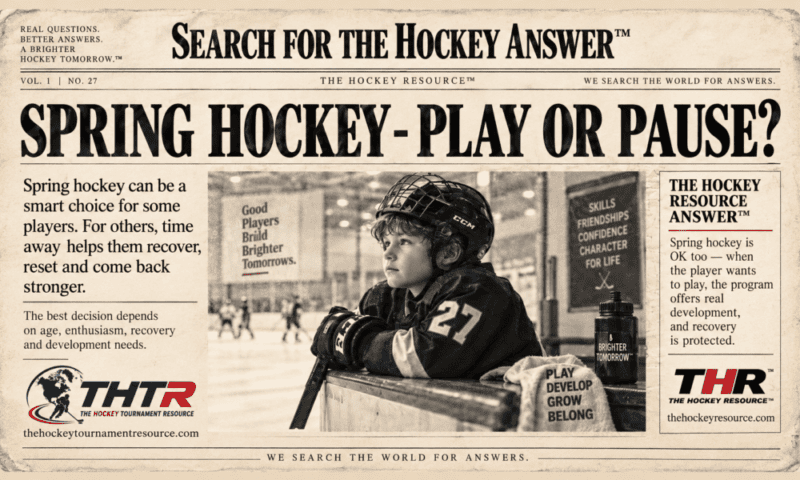
WHAT ABOUT SPRING HOCKEY?
Spring Hockey is not automatically good.
It is not automatically bad.
The value depends on:
- the Player;
- the coaching;
- the amount of Hockey already played;
- the development purpose;
- the schedule;
- the cost;
- the Player’s enthusiasm;
- the recovery available afterward.
SPRING HOCKEY MAY MAKE SENSE WHEN:
- the Player genuinely wants to participate;
- the coaching is strong;
- the program addresses a specific development need;
- the schedule is reasonable;
- meaningful recovery still exists.
SPRING HOCKEY SHOULD BE QUESTIONED WHEN:
- the Player is already exhausted;
- the program simply extends the winter season;
- there is no clear development objective;
- the Parent is registering primarily from fear;
- the child has no meaningful time away.
Before registering, ask:
WHAT WILL MY SON LEARN HERE THAT JUSTIFIES THE ADDITIONAL TIME, MONEY AND WORKLOAD?
That is a far better question than:
WHO ELSE IS PLAYING?
THE MONEY QUESTION PARENTS SHOULD ASK
Specialization can become enormously expensive.
Another Team may bring:
- registration;
- jerseys;
- tournament fees;
- hotels;
- meals;
- travel;
- private training;
- additional equipment;
- time away from work.
A family can spend thousands of dollars while believing every expense represents development.
It does not.
Spending and development are not the same metric.
Before spending another $1,000 or $2,000, ask:
WHAT IS OUR PLAYER’S BIGGEST DEVELOPMENT NEED?
Then direct resources toward that need.
A Player who needs skating improvement may benefit more from quality skating instruction than another tournament.
A Player who needs strength may eventually benefit from age-appropriate physical training.
A Player who needs confidence may need an environment where he handles the puck more.
A Player who is mentally exhausted may need something money cannot buy:
time away.
THE PARENT FEAR TEST™
Before adding another Hockey program, ask yourself:
ARE WE DOING THIS BECAUSE HE NEEDS IT?
Or because another family is doing it?
DOES HE WANT IT?
Or are we afraid he will regret not doing it?
WHAT SPECIFICALLY WILL IMPROVE?
Skating?
Shooting?
Strength?
Decision-making?
Confidence?
IS THE COACHING GOOD ENOUGH TO JUSTIFY THE TIME?
Ice without instruction is not automatically development.
WHAT ARE WE GIVING UP?
Another sport?
Recovery?
Family time?
Money?
Free play?
Enthusiasm?
Those costs do not automatically mean the program is wrong.
They simply belong in the decision.
MORE HOCKEY OR BETTER HOCKEY?
This may be the most important distinction in the entire lesson.
Imagine two off-season choices.
OPTION A
Twenty-five extra games.
Minimal practice.
Little instruction.
Lots of travel.
OPTION B
Ten high-quality skating sessions addressing a known weakness.
Which produces more development?
There is no automatic answer for every Player.
But simply counting ice hours would tell us Option A is “more.”
That does not mean it is better.
The Player does not need the maximum amount of Hockey.
He needs the right development dose.
WHAT SHOULD THE DEVELOPMENT PATH LOOK LIKE?
U5–U7
BUILD THE ATHLETE.
Introduce Hockey.
Develop skating.
Encourage many forms of movement and play.
Avoid building the year around one sport.
U8–U10
BUILD THE ATHLETE AND THE HOCKEY PLAYER.
Develop Hockey fundamentals.
Keep athletic variety.
Choose extra Hockey selectively.
Protect time away.
U11–U14
TARGET DEVELOPMENT NEEDS.
Increase Hockey-specific work where appropriate.
Identify weaknesses.
Use better training rather than merely more games.
Continue other sports where they remain useful and enjoyable.
U15–U18
SPECIALIZE WHEN THE PLAYER AND PATHWAY JUSTIFY IT.
Hockey may become the primary sport.
Training becomes more specific.
Recovery becomes more important.
The Player should increasingly own the commitment.
JUNIOR
TRAIN FOR PERFORMANCE.
Hockey-specific preparation dominates.
The Player is now competing in a performance pathway.
Training quality, recovery, strength, skill and Hockey opportunity become central.
FIVE QUESTIONS TO ASK BEFORE THE NEXT REGISTRATION
1. HOW OLD IS MY SON?
Age changes the answer.
2. WHAT DOES HE NEED TO IMPROVE?
Identify the real development gap.
3. DOES THIS PROGRAM ADDRESS THAT GAP?
If not, why are you buying it?
4. DOES HE WANT TO DO IT?
Player motivation matters.
5. WHAT DOES SAYING YES COST?
Consider money, time, recovery, another sport and family life.
When those five answers make sense together, the decision becomes much clearer.
THE HOCKEY RESOURCE ANSWER™ IN ONE SENTENCE
DO NOT SPECIALIZE YOUR SON IN HOCKEY SIMPLY BECAUSE OTHER PLAYERS ARE DOING MORE. LET AGE, ABILITY, DEVELOPMENT NEEDS, MOTIVATION AND GOALS DETERMINE WHEN HOCKEY SHOULD BECOME HIS PRIMARY SPORT.
15-SECOND VIDEO — THE MAIN ANSWER
“More Hockey does not automatically mean better development. Young Players need Hockey skills, but they also need athleticism, recovery and enthusiasm. Build the athlete first. Specialize when age, ability and goals justify it.”
15-SECOND VIDEO — FEAR OF FALLING BEHIND
“Are you registering for more Hockey because your son needs it, or because another Player is doing it? Those are two different decisions. Development should be driven by need, not fear.”
15-SECOND VIDEO — DEVELOPMENT
“Before adding another tournament, ask what your son actually needs to improve. If skating is the weakness, work on skating. More games don’t automatically fix development problems.”
15-SECOND VIDEO — RECOVERY
“Rest is not lost development. Training stresses the body. Recovery allows adaptation. A serious Hockey development plan needs both. Filling every free day with Hockey is not automatically helping.”
15-SECOND VIDEO — LONG-TERM THINKING
“Don’t build the best ten-year-old Hockey Player you can. Build the athlete who still has room to become a much better Hockey Player at sixteen. Those can be very different development plans.”
15-SECOND VIDEO — PARENT MONEY
“Before spending another thousand dollars on Hockey, ask one question: what specific development need are we paying to improve? More expensive Hockey isn’t automatically better Hockey.”
WHAT DID YOU LEARN?™
Your ten-year-old son finishes his winter Hockey season.
Several teammates immediately join a competitive spring Team.
You are worried he will fall behind.
What should you determine first?
A. How many spring games his teammates are playing.
B. Which program offers the most ice.
C. What your son actually needs for his development right now.
D. Which spring Team has the strongest roster.
THE BEST ANSWER™
C. What your son actually needs for his development right now.
The decision should start with the Player.
Consider:
- age;
- current ability;
- weaknesses;
- training load;
- motivation;
- recovery;
- other athletic opportunities.
Another family’s Hockey calendar does not determine the correct development plan for your son.
IF THE ANSWER IS WRONG
TRY AGAIN.
This is not a race to accumulate the most Hockey.
The goal is to make the best development decision for this Player.
AUDIO LESSON
Should my son specialize in Hockey or play other sports?
For most young Players, early Hockey specialization is unnecessary.
That does not mean Hockey should not be important.
It means young Players need more than Hockey-specific repetitions.
They are still developing as athletes.
Running, jumping, throwing, catching, balancing, reacting and competing in different environments can all contribute to a broader athletic foundation.
As the Player gets older, the balance changes.
At U11 through U14, more targeted Hockey development may make sense.
The important question becomes what the Player actually needs to improve.
By U15 through U18, a serious Player pursuing AAA, Junior, college or another advanced pathway may reasonably make Hockey his primary sport.
But specialization should come from age, ability, goals and the Player’s own motivation.
It should not come from fear that another family is doing more.
Recovery matters too.
A Player cannot simply add training forever and assume every additional hour creates development.
The objective is the right amount of the right training at the right stage.
Build the athlete first.
Then increase Hockey specialization when the Player’s development justifies it.
THE HOCKEY RESOURCE TAKEAWAY™
BUILD THE ATHLETE BEFORE YOU SPECIALIZE THE HOCKEY PLAYER.™
For younger Players:
VARIETY MATTERS.
For developing Players:
TRAINING QUALITY MATTERS.
For older competitive Players:
PURPOSEFUL SPECIALIZATION MAY MATTER.
At every age:
RECOVERY MATTERS.
The objective is not to win the off-season.
It is not to have the fullest calendar.
It is not to make your son look six months ahead of everyone else.
The objective is to build an athlete and Hockey Player who still has the ability, health, motivation and room to improve years from now.
HOW WE REACHED THE HOCKEY ANSWER™
Our research can reach across Hockey organizations, development programs, current studies, expert guidance, public discussion and real-world Hockey experience to find the strongest information available. We compare the evidence, challenge the obvious answer, consider how age, level, position and circumstances may change it, and then combine everything into one clear Hockey answer designed to help you make a better decision.
REAL CURRENT QUESTIONS – REAL CURRENT RESEARCH – REAL CURRENT ANSWERS.™
SEARCH THE WORLD FOR ANSWERS.™
As always, thank you for being part of The Hockey Resource Community.
AMAZON Hockey https://thehockeyresource.com/hockey-products-amazon/
NEW Tournament Search APP
https://play.google.com/store/apps/details?id=com.hockeyresource.hockeytournamentapp&hl=en_CA&pli=1
NEW!!! The Hockey Moments Cards
GUMROAD – eBooks
https://thehockeyresource.gumroad.com
SEE My Interview with the Mental Health Academy