

SEARCH FOR THE HOCKEY ANSWER™
HOCKEY PARENT INTELLIGENCE™
Your child has just finished Hockey tryouts.
For several days, perhaps several weeks, your family has been waiting for the results.
Your child worked hard, attended evaluations and hoped to make the Team.
Then the news arrives.
Your child did not make the Team.
For some Players, disappointment is immediate. There may be tears, anger or embarrassment.
Others say very little, even when the decision hurts.
Parents may experience their own frustration, particularly when they believe their child performed well enough to earn a place.
They may question the selection process, the Coach’s judgment or whether other Players received preferential treatment.
But amid all those emotions, one question matters most.
What should a Hockey parent do next?
THE HOCKEY RESOURCE ANSWER™
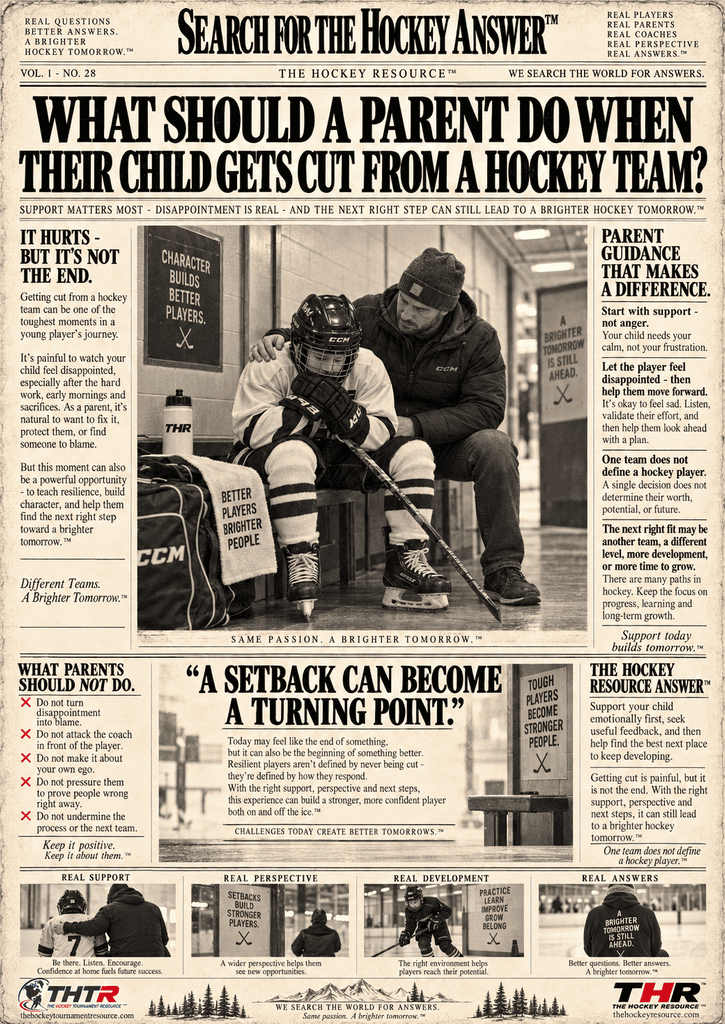
Your first responsibility is to support your child emotionally, not challenge the selection decision. Give your Player time to process the disappointment, seek constructive feedback when appropriate, and then help identify the best available development opportunity.
Being cut from a Hockey Team can be painful.
However, a single Team selection does not determine a child’s ability, value or long-term Hockey potential.
A Player may not be ready for a particular competitive level today.
Another Player may have performed below their ability during evaluations.
In some situations, a Team may simply have more qualified Players than available roster positions.
Selection decisions also involve judgments about positional needs, Team composition and the particular qualities Coaches value.
That does not make every selection decision correct or every tryout process fair.
It does mean parents should avoid assuming that one disappointing result defines their child’s Hockey future.
A Hockey Team selection is a roster decision at a particular moment. It is not a final judgment about a Player’s future.
THE FIRST 24 HOURS – WHAT SHOULD PARENTS SAY?
The period immediately following a disappointing tryout result is particularly important.
Parents may want to offer advice, analyze the evaluations or explain why they disagree with the decision.
However, their child may not be ready for those conversations.
Start by recognizing the disappointment.
You might say –
“I know you really wanted to make that Team. I understand why you’re disappointed. I’m proud of the effort you put into trying.”
Then allow your child to respond.
Some Players want to talk immediately.
Others need time.
Avoid beginning with an assessment of what your child should have done differently during tryouts.
Also resist promising that the Coach made a mistake or that your child deserved a position.
You may believe those things, but discussing them immediately can increase resentment rather than help the Player recover.
The first conversation should be about the child, not the Coach.
SEVEN THINGS HOCKEY PARENTS SHOULD DO AFTER THEIR CHILD GETS CUT
1. Let Your Child Be Disappointed
Disappointment is a normal response to not achieving an important goal.
Parents don’t need to eliminate those feelings immediately.
Listen without minimizing the experience.
A child who is upset about missing a Team may also be worried about losing friendships, disappointing family members or being judged by classmates.
Allow time to process those concerns.
2. Control Your Own Reaction
Parents can feel just as disappointed as their children.
However, expressing anger immediately toward a Coach or association may make the situation worse.
Avoid criticizing other Players who made the Team.
Do not turn a child’s disappointment into an argument between adults.
Your child needs a supportive parent more than an angry representative.
3. Avoid Making Immediate Hockey Decisions
Parents sometimes respond by registering for the first available Team or development program.
Others threaten to leave the association.
Before committing again, determine what your child wants and what opportunities are available.
A thoughtful decision usually has more value than an emotional one.
4. Request Constructive Feedback
After emotions have settled, consider requesting feedback through the organization’s established process.
Ask specific questions.
What strengths did the evaluators identify?
Which skills require improvement?
What should the Player work on before future evaluations?
Feedback should provide useful development information.
It should not become an argument about another Player’s selection.
5. Separate Team Placement From Player Identity
Children sometimes interpret being cut as proof that they are not good Hockey Players.
Parents should challenge that conclusion.
Not making one Team does not erase previous improvement, effort, enjoyment or achievement.
A Player can remain capable and motivated while still needing to improve.
6. Find the Best Available Development Environment
The next priority is identifying where your child can continue learning.
That may involve AA, A, House League, another competitive team, or an appropriate development program.
The highest available level is not automatically the best option.
Coaching quality, opportunities to practice, playing time, confidence and enjoyment all influence development.
7. Help Your Child Set New Goals
Once the Player is ready, help identify a small number of development priorities.
These might involve skating, puck control, shooting, positional awareness, conditioning or confidence.
Goals should be specific and realistic.
Rather than promising that your child will make AAA next year, focus on improvements that can be measured and influenced through practice.
The objective is to turn a disappointing result into useful information, not a reason to abandon Hockey.
SHOULD PARENTS CHALLENGE THE COACH’S DECISION?
This question requires judgment.
A parent who disagrees with a selection decision is not automatically wrong.
Evaluation systems are not perfect.
Coaches may see different strengths and weaknesses in the same Player.
Selection criteria may also be unclear.
However, disagreeing with a decision does not necessarily mean the process was unfair.
Parents should distinguish between two different concerns.
A disagreement about Player ability is generally best addressed through constructive feedback and future development.
A concern about procedural fairness, such as a documented failure to follow published evaluation rules, may justify a formal question or review through the association’s established procedures.
Parents should avoid public accusations, personal attacks or confrontations in front of Players.
A respectful request for clarification is more likely to produce useful information.
And if the decision stands, the priority remains helping the child find a productive next opportunity.
DOES GETTING CUT FROM AAA MEAN YOUR CHILD SHOULD QUIT COMPETITIVE HOCKEY?
No.
A Player who does not make AAA may still have worthwhile opportunities at AA or another level.
The most important question is where the Player can receive appropriate instruction and meaningful opportunities to contribute.
Consider two situations.
Player A makes an AAA Team but receives limited ice time, little individual instruction and few opportunities in important game situations.
Player B plays AA with a qualified Coach, receives substantial practice attention, earns meaningful playing time and develops confidence.
In some circumstances, either environment may be appropriate.
However, the higher Team designation alone does not establish which Player will improve more.
The Hockey Resource™ believes development opportunities should be evaluated on their actual benefits, not simply the letters attached to a Team.
WHAT SHOULD PARENTS DO AT DIFFERENT AGES?
U5–U7 – PROTECT THE LOVE OF HOCKEY
At these ages, participation, enjoyment, fundamental skating and confidence should receive priority.
Competitive selection should never become the central purpose of a young child’s Hockey experience.
If a child does not receive a desired placement, parents should emphasize the opportunities still available to play, learn and have fun.
THE HOCKEY RESOURCE RECOMMENDATION™
Choose a welcoming environment with age-appropriate coaching and plenty of opportunities to participate.
Parent takeaway – A six-year-old does not need a prestigious Team. A six-year-old needs a positive Hockey experience.
U8–U10 – BUILD CONFIDENCE AND FUNDAMENTAL SKILLS
Young Players develop at different rates.
Skating ability, coordination, puck skills and confidence can vary considerably.
A disappointing Team placement should not become a permanent label.
Parents should concentrate on the quality of coaching and opportunities to develop fundamental skills.
THE HOCKEY RESOURCE RECOMMENDATION™
Find a Team where the Player receives suitable instruction, opportunities to practise and a positive learning environment.
Parent takeaway – Being on the right development Team matters more than being on the highest-ranked Team.
U11–U14 – UNDERSTAND DIFFERENCES IN DEVELOPMENT
During these years, differences in physical growth and maturation can influence Player performance.
Some Players develop strength and size earlier than others.
That can affect evaluations, particularly when Coaches are selecting Teams for immediate competitive performance.
However, physical maturity alone does not determine long-term potential.
Parents should evaluate skating ability, technical skills, Hockey understanding and opportunities for future improvement.
THE HOCKEY RESOURCE RECOMMENDATION™
Seek useful evaluation feedback and identify two or three realistic development priorities.
Consider whether another competitive level would provide better coaching, ice time and confidence-building opportunities.
Parent takeaway – A disappointing selection at twelve or thirteen does not establish a Player’s Hockey ceiling.
U15–U18 – EVALUATE THE NEXT COMPETITIVE OPPORTUNITY
At older ages, Team placement may have greater implications for competitive pathways.
Players hoping to pursue Junior Hockey or higher levels should realistically assess their abilities, opportunities and development needs.
Getting cut may indicate that certain skills require improvement or that the Player is not currently competitive at the desired level.
Parents should avoid creating unrealistic expectations.
Equally, they should not assume every pathway has closed.
THE HOCKEY RESOURCE RECOMMENDATION™
Evaluate alternative Teams based on coaching quality, playing opportunities, training resources and realistic advancement possibilities.
Older Players should increasingly take responsibility for requesting feedback and managing their development plans.
Parent takeaway – Choose the next opportunity that helps the Player improve, not simply the option that sounds most impressive.
JUNIOR HOCKEY – MAKE A REALISTIC DEVELOPMENT PLAN
Being released from or failing to make a Junior Team can have more immediate consequences for a Player’s pathway.
Roster decisions may reflect performance, age eligibility, positional needs, recruitment and Team strategy.
Players should seek specific feedback wherever available and assess realistic opportunities at other appropriate levels.
THE HOCKEY RESOURCE RECOMMENDATION™
Develop an honest assessment of current ability, available opportunities and the training required to improve.
Consider education, finances, age eligibility and future goals when evaluating the next step.
Player takeaway – A roster decision may close one opportunity without necessarily closing every opportunity.
WHAT IF YOUR CHILD IS A GOALIE?
Goalies experience unique challenges during Team selections.
Many Teams carry only two Goalies, creating a limited number of roster positions.
A Goalie may perform well during evaluations and still miss selection.
Coaches may consider technical skills, positional needs, current performance and their expectations for the season.
Parents should therefore avoid interpreting a single selection result as a complete measure of Goalie ability.
When seeking feedback, ask about specific technical and tactical development needs.
These may include skating, positioning, puck tracking, rebound control, recovery movement and decision-making.
THE HOCKEY RESOURCE GOALIE PERSPECTIVE™
A qualified Goalie Coach and meaningful opportunities to play may provide greater development value than the prestige of being listed on a higher-level roster.
A Goalie needs quality instruction and opportunities to develop, not simply a higher-level Team jacket.
SHOULD A PARENT TELL THEIR CHILD THE COACH WAS WRONG?
Not without a sound factual basis.
Parents often want to defend their children, particularly when they believe an evaluation was inaccurate.
However, repeatedly telling a Player that Coaches are incompetent or unfair can prevent the Player from considering useful feedback.
It can also undermine confidence in future Coaches.
A more productive approach is to acknowledge that selection decisions involve judgment.
Parents can disagree respectfully while still helping their child focus on what can be improved.
You might say –
“We may not agree with the decision, but we can still use this experience to find a good place for you to keep developing.”
That message avoids blaming the Player or automatically blaming the Coach.
WHAT IF YOUR CHILD WANTS TO QUIT HOCKEY?
Take that statement seriously, particularly when it follows a painful disappointment.
However, avoid treating the first emotional reaction as a permanent decision.
Give your child time to recover.
Then discuss what they are experiencing.
Do they no longer enjoy Hockey?
Are they embarrassed about Team placement?
Are they concerned about friendships?
Do they feel pressure to compete at a particular level?
Or have their interests genuinely changed?
The answers matter.
Parents should not force a child to continue solely to prove resilience.
Nor should they assume one disappointing evaluation means the child no longer loves Hockey.
Sometimes a short break or different Team environment can help.
At other times, a child may genuinely want to pursue another activity.
The goal is to support the child, not protect the family’s Hockey ambitions.
FIVE THINGS PARENTS SHOULD NEVER DO AFTER A TEAM CUT
1. Criticize other Players who made the Team.
Children should not be placed in the middle of adult comparisons.
2. Confront the Coach immediately after evaluations.
Allow emotions to settle and follow established communication procedures.
3. Tell your child they were robbed without evidence.
That reaction may increase resentment and make it harder to move forward.
4. Spend money on unnecessary training out of panic.
Development programs should address actual needs rather than parental frustration.
5. Treat a Team selection as a measure of your child’s worth.
Your child’s identity, friendships and value extend far beyond competitive Hockey.
THE HOCKEY RESOURCE PERSPECTIVE™
IS MAKING THE BEST TEAM ALWAYS THE BEST THING FOR PLAYER DEVELOPMENT?
Not necessarily.
Parents often judge Hockey progress by Team selection.
Making AAA can become a symbol of success.
Missing AAA can feel like failure.
However, development is more complicated than that.
A Player’s progress depends on instructional quality, meaningful practice, appropriate competition, confidence, motivation and opportunities to participate.
A prestigious Team does not guarantee those benefits.
A lower competitive level does not automatically prevent them.
This does not mean competitive level is unimportant.
Playing against stronger opponents can create useful challenges when a Player is ready for them.
The key is finding an environment where the Player can realistically develop.
Parents should therefore ask a different question after a disappointing Team selection.
Instead of asking –
“How do we get back onto that Team?”
Consider asking –
“Where can my child become the best Hockey Player they are capable of becoming?”
Those questions may lead to different decisions.
The second is more directly connected to long-term development.
THE HOCKEY RESOURCE TAKEAWAY™
Getting cut from a Hockey Team can be disappointing.
However, the parent’s response can influence whether the experience becomes a lasting setback or a constructive turning point.
Support your child before analyzing the decision.
Allow time for disappointment.
Seek meaningful feedback.
Find an appropriate development environment.
Help the Player set realistic goals.
Above all, remember that Hockey development takes place over many seasons.
ONE TEAM DOES NOT DEFINE A HOCKEY PLAYER.™
GETTING CUT FROM A TEAM DOES NOT MEAN GETTING CUT FROM A HOCKEY FUTURE.™
THREE WAYS TO LEARN™
ONE QUESTION. ONE RESEARCHED ANSWER. THREE WAYS TO LEARN.
READ IT. TAKE THE QUIZ. LISTEN TO THE AUDIO.
LEARN WHEN IT FITS YOUR LIFE.™
HOW WE REACHED THE HOCKEY ANSWER™
Our research can reach across Hockey organizations, development programs, current studies, expert guidance, public discussion and real-world Hockey experience to find the strongest information available. We compare the evidence, challenge the obvious answer, consider how age, level, position and circumstances may change it, and then combine everything into one clear Hockey answer designed to help you make a better decision.
As always, thank you for being part of The Hockey Resource Community.
AMAZON Hockey https://thehockeyresource.com/hockey-products-amazon/
NEW Tournament Search APP
https://play.google.com/store/apps/details?id=com.hockeyresource.hockeytournamentapp&hl=en_CA&pli=1
NEW!!! The Hockey Moments Cards
GUMROAD – eBooks
https://thehockeyresource.gumroad.com
SEE My Interview with the Mental Health Academy