

Player son loves Hockey.
Player sounds like the easiest development problem a Parent could have.
He wants to practice.
He wants another game.
He wants spring Hockey.
Then summer Hockey appears.
A skills camp follows.
Another tournament is announced.
Before long, the question is no longer whether your son enjoys Hockey.
The question becomes:
Can a young Player play so much Hockey that more begins producing less development?
For many Hockey families, that is difficult to judge.
A busy schedule can look like commitment.
More games can feel like progress.
Extra ice can seem like an advantage.
Yet development does not come only from how often a Player steps onto the ice.
It comes from the relationship between training, teaching, competition, recovery, physical growth, motivation and enjoyment.
At some point, adding Hockey can stop helping.
The difficult part is identifying that point before the Player becomes injured, exhausted or simply tired of the game.
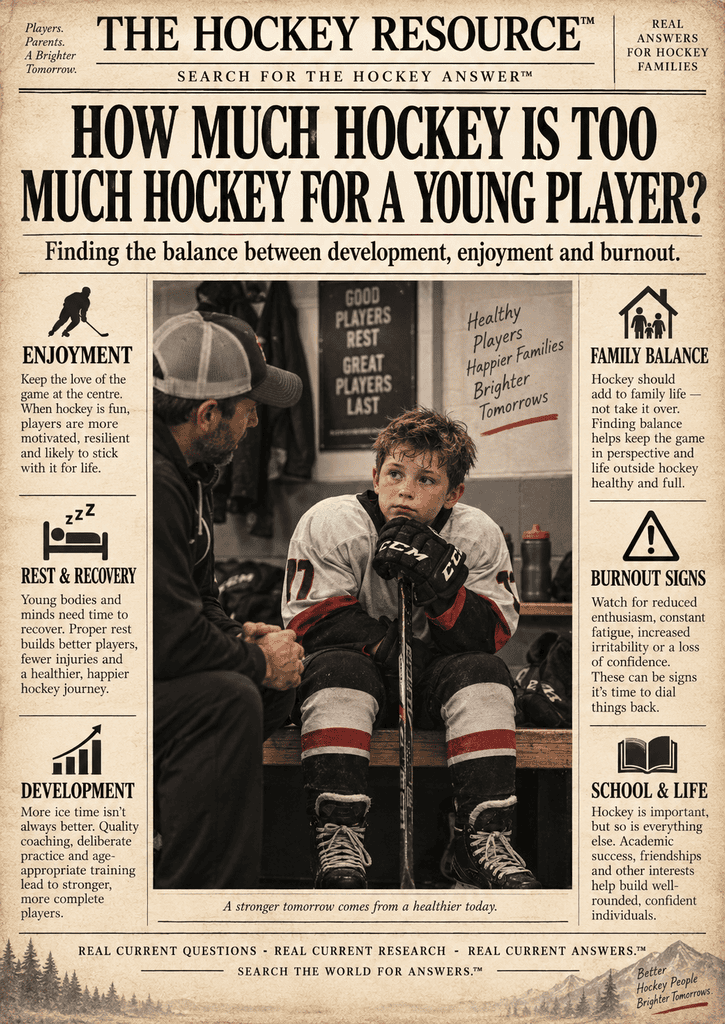
THE HOCKEY RESOURCE ANSWER™
There is no single number of Hockey hours or games that is “too much” for every young Player.
Age matters.
Intensity matters.
The quality of the Hockey matters.
Recovery matters.
Physical growth matters.
Another major factor is whether the Player still wants the workload.
A young child playing recreational Hockey twice a week is in a completely different situation from a U16 AAA Player following a structured high-performance program.
The right question is therefore not:
HOW MUCH HOCKEY IS TOO MUCH FOR EVERYONE?
Ask instead:
WHEN DOES THIS PLAYER’S HOCKEY LOAD BEGIN TO interfere with development, recovery, health, school, family life or enjoyment?
That is the point where more Hockey may have become too much Hockey.
WHY THIS QUESTION IS GETTING HARDER
Minor Hockey no longer lives neatly inside one winter season.
Families can now find Hockey almost every month of the year.
Winter Teams lead into spring Teams.
Spring can lead into summer showcases.
Private instruction operates year-round.
Tournament Teams appear between regular Teams.
Development camps begin before the previous season feels finished.
None of those opportunities is automatically bad.
Some are excellent.
The problem appears when every opportunity is treated as necessary.
A Parent begins thinking:
If we skip this, somebody else is getting ahead.
That fear can turn optional development into an endless schedule.
Eventually, the Hockey calendar starts controlling the Player rather than serving the Player.
MORE HOCKEY DOES NOT AUTOMATICALLY MEAN MORE DEVELOPMENT
This distinction has to sit at the centre of the answer.
Ice time can be valuable.
Games can be valuable.
Skill sessions can be valuable.
But value depends on what happens during those hours.
Consider a Player who adds twenty offseason games.
If those games provide quality competition, good coaching and meaningful puck involvement, they may help.
Now imagine the same Player has a skating deficiency that limits everything he does.
Twenty more games might simply give him twenty more opportunities to skate inefficiently.
A focused skating program may create more actual development with fewer total hours.
The important measurement is not simply:
HOW MUCH HOCKEY DID HE PLAY?
The stronger measurement is:
WHAT IMPROVED BECAUSE HE PLAYED IT?
That is the difference between Hockey volume and Hockey development.
PRODUCTIVE HOCKEY VERSUS EMPTY HOCKEY
Not every additional hour has equal value.
Productive Hockey has a purpose.
The Player may be developing skating, puck control, shooting, strength, decision-making or a specific positional skill.
Feedback is available.
Mistakes are corrected.
The Player remains engaged.
Recovery still exists.
Empty Hockey is different.
It may be another tournament because everyone else entered.
Perhaps the Player is exhausted but continues because the fee has already been paid.
Sometimes the schedule contains more games than meaningful practices.
In other cases, the Player keeps repeating the same weaknesses without instruction.
The total Hockey volume rises.
Development does not necessarily rise with it.
THE DEVELOPMENT EQUATION NEEDS RECOVERY
Training creates stress.
That is necessary.
A Player cannot become stronger, faster or more skilled without challenging the body and brain.
The mistake is assuming that improvement happens only during the work.
Recovery is part of the adaptation process.
Hockey Canada describes recovery as an active part of Player development that is too often overlooked, even when discussing elite athletes.
The American Academy of Pediatrics makes the same principle clear in broader youth sport.
Its updated guidance recommends young athletes strive for at least one to two days each week away from competition and sport-specific training so they can recover physically and psychologically.
The AAP also recommends two to three months away from each specific sport during the year, which can be divided into shorter blocks.
That does not mean the Player has to sit on a couch for three months.
He can play another sport.
He can train differently.
He can move.
He can have fun.
What changes is the repetitive, sport-specific workload.
WHY REST CAN FEEL WRONG TO HOCKEY PARENTS
Rest is difficult to see.
A skating session looks productive.
A tournament produces games.
Private instruction produces drills.
A blank Saturday produces nothing visible.
That can make a Parent feel as though development has stopped.
But the body does not interpret the calendar that way.
Muscles recover.
Fatigue decreases.
Minor aches may settle.
Mental pressure can fall.
Enthusiasm may return.
A Player can come back wanting Hockey rather than simply continuing Hockey because the schedule says he must.
So a rest day is not automatically lost development.
Sometimes it is what allows previous development work to become useful.
WHAT DOES TOO MUCH HOCKEY LOOK LIKE?
There is no single symptom.
Usually, Parents need to look for a pattern.
Physical signs can include unusual soreness, persistent aches, recurring minor injuries, reduced energy or a Player who seems slower despite doing more training.
Performance may also change.
Instead of improving, the Player becomes flat.
Skills look less sharp.
Decision-making slows.
Effort becomes inconsistent.
Outside the rink, other clues may appear.
Sleep changes.
Schoolwork suffers.
Mood becomes more irritable.
Family time disappears.
The Player stops asking to practise.
Perhaps the biggest warning sign is when a child who once loved going to Hockey begins looking for reasons not to go.
One bad day means very little.
A sustained pattern deserves attention.
FATIGUE IS NOT THE SAME AS LAZINESS
This distinction matters.
Young athletes get tired.
A Player can also have an occasional bad practice.
That does not automatically mean the schedule is excessive.
At the same time, adults can misread fatigue as poor effort.
A tired Player may appear unfocused.
Heavy legs can look like laziness.
Mental exhaustion may look like a bad attitude.
Before demanding more effort, ask whether the Player is receiving enough recovery to produce that effort.
Sometimes the answer to poor performance is not another practice.
It is rest.
WHAT IS AN OVERUSE INJURY?
Many Hockey injuries happen instantly.
A collision occurs.
A Player blocks a shot.
Someone falls awkwardly.
Overuse problems are different.
They develop gradually when repetitive stress accumulates faster than the body can recover.
Young athletes require particular care because their bodies are still growing.
Training loads interact with growth, strength, biomechanics, sleep, previous injuries and many other factors.
The American Academy of Pediatrics specifically warns about repetitive stress without sufficient recovery because accumulated damage can lead to overuse injuries.
That does not mean more Hockey automatically causes injury.
It means training load without adequate recovery increases concern.
WHAT IS OVERTRAINING?
Overtraining is not simply being tired after a difficult weekend.
A hard tournament should make a Player tired.
The concern appears when repeated heavy training loads continue without enough recovery and performance begins deteriorating instead of improving.
Possible warning signs can include persistent fatigue, mood changes, poor sleep, reduced performance and increased injury or illness.
Parents should not diagnose medical conditions themselves.
Persistent physical or psychological symptoms belong with qualified health professionals.
The Hockey lesson is simpler:
A DEVELOPMENT PLAN SHOULD NEVER REQUIRE THE PLAYER TO IGNORE HIS BODY IN ORDER TO PROVE COMMITMENT.
WHAT ABOUT BURNOUT?
Burnout may be the most expensive loss of all because the Player can leave Hockey entirely.
The AAP describes burnout as physical or mental exhaustion combined with a reduced sense of accomplishment and increasing devaluation of sport.
In normal Parent language:
The Player stops caring.
Hockey becomes work.
Excitement disappears.
Something that once created joy starts creating pressure.
A Player does not need to hate Hockey before adults pay attention.
The earlier signals matter.
Is he still excited for practice?
Does he ever voluntarily play Hockey away from organized sessions?
Does he talk about the game positively?
Can he enjoy a weekend with no Hockey?
Those questions can reveal things a stat sheet cannot.
WHEN “I WANT MORE HOCKEY” IS STILL NOT THE WHOLE ANSWER
A motivated Player may genuinely want Hockey every day.
That enthusiasm is valuable.
Parents should listen to it.
Still, children do not have to manage their own complete training load.
A ten-year-old might happily eat ice cream at every meal too. Enthusiasm alone is not always the entire planning system.
Adults still have to consider:
health;
recovery;
school;
family;
physical growth;
long-term development.
The goal is not to stop enthusiasm.
It is to protect it.
U5–U7: MORE PLAY, NOT MORE PROGRAMMING
At this age, a young Player does not need a professional schedule.
Hockey should be fun.
Skating should be developed.
Basic puck skills matter.
Yet the child’s physical world should be much larger than Hockey.
Running, jumping, throwing, catching, climbing, swimming and free play all contribute to development.
THE HOCKEY RESOURCE ANSWER™ FOR U5–U7
For most children, two things matter more than maximizing Hockey volume:
QUALITY EXPERIENCE
and
LOVE OF THE GAME.
A child who leaves the rink wanting more Hockey may be in a healthier place than one who played another unnecessary game and leaves exhausted.
15-SECOND VIDEO — U5–U7
“At six or seven, more Hockey is not the goal. Better movement, better skating and loving the game matter more. Leave some room for the child to want to come back.”
U8–U10: WATCH THE CALENDAR BEGINNING TO EXPAND
These are dangerous ages for accidental overload.
The Player may have a regular Team.
Then spring Hockey appears.
Private skills follow.
A tournament Team sends an invitation.
Nobody makes one enormous decision.
Instead, families make ten small decisions.
Eventually, the calendar is full.
THE HOCKEY RESOURCE ANSWER™ FOR U8–U10
Keep Hockey development important.
Do not allow every Hockey opportunity to become mandatory.
At this age, Parents should still protect:
recovery;
other sports;
free play;
family time;
enthusiasm.
A good offseason may contain some Hockey.
It does not need to contain Hockey every week.
15-SECOND VIDEO — U8–U10
“Too much Hockey often doesn’t happen with one big decision. It happens when ten good opportunities get stacked together. Parents have to manage the total load, not just each individual program.”
U11–U14: START MEASURING PURPOSE
The Player can now handle more structure.
Serious Hockey-specific development may become increasingly valuable.
That still does not mean every extra hour helps equally.
THE HOCKEY RESOURCE ANSWER™ FOR U11–U14
Ask what each additional program is supposed to accomplish.
Skating weakness?
Choose skating work.
Poor shot mechanics?
Target the shot.
Strength and coordination concerns?
Address athletic development.
Another 25 games should not automatically become the answer to every development problem.
At this age, the calendar should become more intentional, not simply more crowded.
15-SECOND VIDEO — U11–U14
“At twelve or thirteen, the question isn’t how much Hockey can we add. Ask what the Player needs to improve. More Hockey without a purpose can just become more fatigue.”
U15–U18: HIGHER WORKLOAD CAN BE APPROPRIATE
Older competitive Players are different.
A serious U16 or U18 Player may legitimately train far more than a U9 Player.
AAA, prep and Junior pathways require greater Hockey-specific commitment.
Strength programs become more structured.
Conditioning becomes more sophisticated.
Position-specific instruction matters.
Video and tactical learning can increase.
THE HOCKEY RESOURCE ANSWER™ FOR U15–U18
More Hockey can be appropriate when the program is properly designed.
Higher workload needs to be matched with higher-quality recovery.
The Player should increasingly understand:
why he is training;
what he is developing;
how his body is responding;
when recovery is needed.
Serious training is not simply doing the maximum possible amount.
It is managing the correct workload.
15-SECOND VIDEO — U15–U18
“A serious sixteen-year-old may need a lot of Hockey. But elite development isn’t maximum volume. It’s the right training, the right intensity and enough recovery to actually improve.”
JUNIOR: PERFORMANCE CHANGES THE QUESTION
At Junior, the Player is operating in a performance environment.
Hockey is likely the primary competitive sport.
Workload can be substantial.
The question now becomes:
Is the training load producing performance or merely producing fatigue?
Junior Players need sophisticated management of:
strength;
conditioning;
skills;
team practices;
games;
travel;
nutrition;
sleep;
recovery.
Adding work for the sake of appearing committed is not high-performance thinking.
DO GAMES COUNT THE SAME AS PRACTICES?
No.
They create different demands.
Games involve competition, decision-making, emotional pressure and game-specific intensity.
Practices can provide more repetitions and more teaching.
Skill sessions may concentrate heavily on one technical area.
Strength work adds another physical load.
Parents should therefore stop counting only “days at the rink.”
A Player might have five Hockey-related days that are carefully managed.
Another could have four brutal days involving games, travel and intense training.
Total workload matters more than simply counting calendar squares.
WEEKEND TOURNAMENTS CAN HIDE THE REAL LOAD
Tournament weekends deserve special attention.
A family may say:
He only played Hockey three days this week.
Those three days could include five games, warmups, travel, poor sleep and long periods sitting in a car.
The calendar says three Hockey days.
The body experienced much more.
That does not make tournaments bad.
It means Parents should consider the complete physical and mental load.
SCHOOL IS PART OF THE LOAD TOO
A young athlete does not recover inside a sports-only universe.
School creates stress.
Homework requires time.
Exams affect sleep.
Family responsibilities exist.
Travel takes energy.
A difficult academic week combined with heavy Hockey can produce a completely different workload than the same Hockey schedule during a school break.
Good development considers the whole young person.
Not merely the Hockey Player.
GROWTH CHANGES THE EQUATION
Young athletes do not develop in a straight line.
Growth spurts can temporarily change coordination, balance and physical comfort.
A Player who seems awkward may not suddenly need twice as much Hockey.
His body may simply be changing rapidly.
Training needs should adapt to development.
Hockey Canada’s Long-Term Player Development philosophy emphasizes doing the right thing for the Player at the right developmental stage rather than treating every Player identically.
That principle is especially valuable here.
HOW MUCH TIME OFF SHOULD A PLAYER GET?
There is no single perfect Hockey calendar.
However, credible sports-medicine guidance gives Parents useful boundaries.
The American Academy of Pediatrics recommends young athletes aim for at least one to two days per week away from competition and sport-specific training.
Its guidance also recommends approximately two to three months away from each specific sport during the year, which may be divided into shorter periods.
USA Hockey likewise warns against too much offseason ice for young Players and encourages participation in other sports and activities.
These are not punishments for committed Players.
They are attempts to protect long-term development.
DOES TIME OFF MEAN LOSING SKILL?
Some rust can occur.
That is normal.
A Player taking several weeks away may need time to regain Hockey timing.
The larger question is whether the break improves physical recovery, athletic variety and motivation enough to justify that temporary rust.
For many young Players, the answer can be yes.
The objective is not to look perfect during the first practice back.
The objective is to continue developing for years.
THE PARENT TEST: IS THIS HOCKEY STILL HELPING?
Before adding another program, ask:
WHAT IS THE PURPOSE?
Development should have a reason.
WHAT IS THE TOTAL LOAD?
Include Team Hockey, private sessions, tournaments, travel and other sports.
WHEN DOES RECOVERY HAPPEN?
Do not assume recovery will magically appear somewhere in the calendar.
HOW DOES THE PLAYER FEEL?
Look beyond whether he says “I’m fine.”
IS HE STILL IMPROVING?
More work with declining performance deserves attention.
DOES HE STILL LOVE GOING?
Enjoyment is not childish. It is one of the reasons Players stay in the sport long enough to become good.
THE HOCKEY RESOURCE RED FLAGS™
More Hockey deserves reconsideration when several warning signs appear together.
Persistent soreness matters.
Repeated minor injuries deserve attention.
Declining performance despite increased training is important.
Changes in sleep, mood or enthusiasm should not be dismissed.
School problems may also indicate the overall schedule has become too demanding.
Most importantly, listen when the Player repeatedly says he needs a break.
Children do not become tougher because adults refuse to hear them.
THE PARENT FEAR PROBLEM
Hockey families are surrounded by comparison.
Another Player has a skating Coach.
Someone is on two Teams.
A teammate attends every camp.
Another family never seems to take a weekend off.
Comparison creates pressure.
Soon, Parents stop asking what their own Player needs and start copying somebody else’s calendar.
That is backwards.
ANOTHER PLAYER’S WORKLOAD IS NOT YOUR SON’S DEVELOPMENT PLAN.
Different Players have different bodies, goals, maturity, ability and motivation.
Development should be individualized.
MORE HOCKEY CAN SOMETIMES BE THE RIGHT ANSWER
This lesson is not anti-Hockey.
Sometimes the Player genuinely needs more.
A U14 Player with excellent recovery and strong motivation may benefit from additional skill work.
An older AAA Player might need more strength training.
A serious Goaltender may require position-specific instruction.
The key is that the additional workload has a clear purpose and fits inside a complete development plan.
“More” becomes useful when it is the right tool.
LESS HOCKEY CAN SOMETIMES CREATE BETTER HOCKEY
The opposite can also be true.
Remove meaningless games.
Add recovery.
Replace one tournament with targeted skill instruction.
Let the Player participate in another sport.
Allow a genuine offseason.
The total Hockey hours may fall.
Development may improve.
That sounds contradictory only if we assume volume and development are the same thing.
They are not.
AGE-BY-AGE HOCKEY RESOURCE GUIDE™
U5–U7
PRIMARY OBJECTIVE: FUN, MOVEMENT AND BASIC HOCKEY SKILLS.
Avoid year-round structured Hockey.
Leave room for free play and other activities.
Protect enthusiasm.
U8–U10
PRIMARY OBJECTIVE: FUNDAMENTALS WITHOUT OVERLOADING THE CALENDAR.
Quality Hockey matters.
Offseason variety still matters too.
Parents should manage the total schedule.
U11–U14
PRIMARY OBJECTIVE: PURPOSEFUL DEVELOPMENT.
Increase Hockey-specific work when it addresses a real need.
Reduce meaningless volume.
Recovery remains important.
U15–U18
PRIMARY OBJECTIVE: HIGHER PERFORMANCE WITH BETTER LOAD MANAGEMENT.
Greater Hockey commitment can be appropriate.
Training and recovery need to become more sophisticated.
JUNIOR
PRIMARY OBJECTIVE: PERFORMANCE.
Workload may be high.
Every part of the program should support performance rather than simply prove commitment.
THE HOCKEY RESOURCE ANSWER™ IN ONE SENTENCE
HOCKEY BECOMES TOO MUCH WHEN THE TOTAL LOAD BEGINS TAKING MORE FROM THE PLAYER’S DEVELOPMENT, HEALTH, RECOVERY OR ENJOYMENT THAN IT IS GIVING BACK.
That threshold will be different for different Players.
Parents should stop looking for one magic number.
Start looking at the whole Player.
15-SECOND VIDEO — MAIN ANSWER
“How much Hockey is too much? There isn’t one magic number. It becomes too much when the workload starts hurting recovery, development, health or enjoyment. More Hockey only helps when the Player can still benefit from it.”
15-SECOND VIDEO — RECOVERY
“Rest isn’t the opposite of Hockey development. It’s part of Hockey development. Training creates stress. Recovery lets the Player adapt. If there is never time to recover, more can eventually become less.”
15-SECOND VIDEO — PARENT COMPARISON
“Another Player’s Hockey calendar is not your son’s development plan. Different Players have different needs, bodies and goals. Stop counting somebody else’s ice time and start measuring your own Player’s development.”
15-SECOND VIDEO — TOURNAMENTS
“Five tournament games in three days isn’t just three days of Hockey. Add travel, warmups, poor sleep and emotional intensity. Parents need to measure the real workload, not just the calendar.”
15-SECOND VIDEO — THE LONG GAME
“The goal isn’t to play the most Hockey at ten. The goal is to still be healthy, motivated and improving at sixteen. Long-term development sometimes requires knowing when enough is enough.”
WHAT DID YOU LEARN?™
Your U10 son has regular Team Hockey, a weekly private skills session and an upcoming five-game weekend tournament.
A spring program offers additional practices starting immediately afterward.
What should you evaluate first?
A. Whether his teammates are joining.
B. Whether the spring program has the strongest roster.
C. His total current workload, recovery and actual development need.
D. Whether more Hockey will make him look sharper at the next tryout.
THE BEST ANSWER™
C. His total current workload, recovery and actual development need.
No individual program can be evaluated properly without considering everything else the Player is already doing.
A good program can still become the wrong program when it is stacked onto an overloaded schedule.
WHY A IS NOT THE BEST ANSWER
Another family’s decision does not determine what your son needs.
WHY B IS NOT THE BEST ANSWER
Roster quality tells you little about whether the additional workload is appropriate.
WHY D IS NOT THE BEST ANSWER
Short-term sharpness should not automatically override long-term development and recovery.
IF THE ANSWER IS WRONG
TRY AGAIN.
The decision is not:
Is this program good?
The better question is:
Is this program good for this Player, with this workload, right now?
AUDIO LESSON
How much Hockey is too much Hockey for a young Player?
There is no single number that works for every child.
A U7 Player and a U17 AAA Player should not have the same schedule.
The better way to judge Hockey volume is to look at what the total workload is doing to the Player.
Is he improving?
Is he recovering?
Does his body feel good?
Is school manageable?
Does he still enjoy going to the rink?
More Hockey can help when it has a clear development purpose.
Extra skating may improve a weakness.
Quality skills work can help a motivated Player.
Older competitive Players can appropriately handle more Hockey-specific training.
But more can also become too much.
Repeated games, practices, private instruction, tournaments and travel can accumulate faster than Parents realize.
Recovery is part of development.
Young athletes need days away from sport-specific training and meaningful periods away from each sport during the year.
Parents should also watch for persistent soreness, fatigue, mood changes, declining performance or a Player who is losing enthusiasm.
Another family’s Hockey calendar is not your son’s development plan.
Do not count only hours.
Measure what those hours are producing.
The Hockey Resource Answer™ is simple:
Hockey becomes too much when the load begins taking more from the Player’s health, recovery, development or enjoyment than it gives back.
THE HOCKEY RESOURCE TAKEAWAY™
MORE HOCKEY IS ONLY BETTER WHEN THE PLAYER CAN STILL BENEFIT FROM MORE HOCKEY.™
Young Players need development.
They also need recovery.
Serious Players need commitment.
They still need rest.
Parents should value opportunity.
They must also know when to decline one.
The goal is not to produce the busiest ten-year-old in Hockey.
The goal is to build a Player who remains healthy, motivated and capable of becoming much better later.
HOW WE REACHED THE HOCKEY ANSWER™
Our research can reach across Hockey organizations, development programs, current studies, expert guidance, public discussion and real-world Hockey experience to find the strongest information available. We compare the evidence, challenge the obvious answer, consider how age, level, position and circumstances may change it, and then combine everything into one clear Hockey answer designed to help you make a better decision.
REAL CURRENT QUESTIONS – REAL CURRENT RESEARCH – REAL CURRENT ANSWERS.™
SEARCH THE WORLD FOR ANSWERS.™
As always, thank you for being part of The Hockey Resource Community.
AMAZON Hockey https://thehockeyresource.com/hockey-products-amazon/
NEW Tournament Search APP
https://play.google.com/store/apps/details?id=com.hockeyresource.hockeytournamentapp&hl=en_CA&pli=1
NEW!!! The Hockey Moments Cards
GUMROAD – eBooks
https://thehockeyresource.gumroad.com
SEE My Interview with the Mental Health Academy