

Every Player Develops At Their Own Pace: Why Hockey Development Is Not a Race
One of the biggest mistakes in youth hockey is assuming that every player should develop on the same timeline.
Some athletes grow physically at an early age. Others mature later. Certain players dominate at age 10 but struggle by age 15. Meanwhile, many future leaders, top performers, and even professional players were overlooked during their early hockey years.
Development is not a straight line.
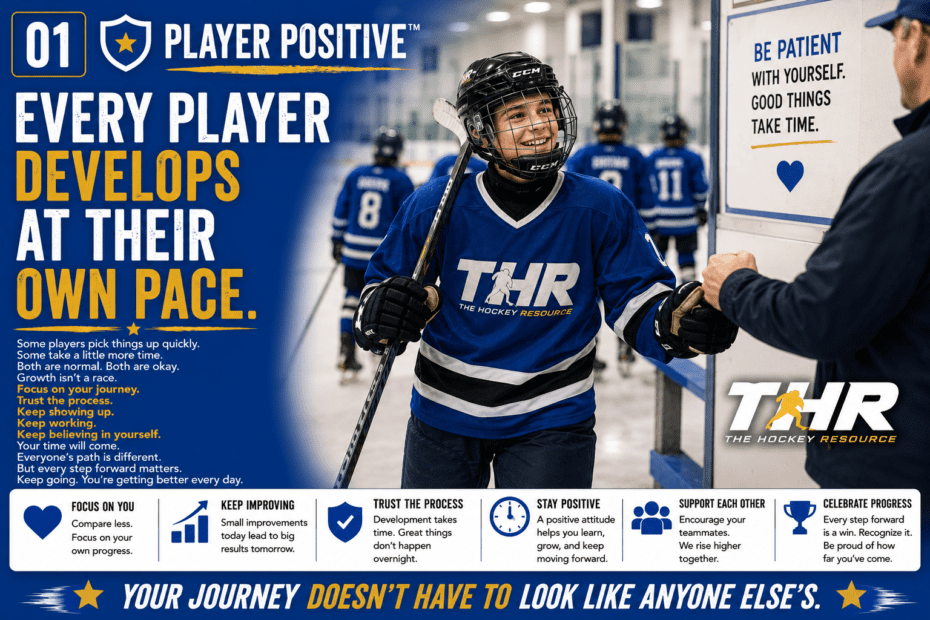
The image above captures an important truth about hockey and life: every player develops at their own pace.
A smiling young player steps onto the ice wearing a THR jersey while being encouraged by a coach. Behind that moment is a powerful reminder that progress happens differently for every athlete. Success is not measured by where a player stands today. Growth is measured by how committed they are to becoming better tomorrow.
Hockey Is a Long-Term Journey
Youth hockey often creates pressure to compare.
Parents compare.
Players compare.
Teams compare.
Social media heightens the temptation to judge progress by goals, statistics, rankings, or roster positions.
However, development rarely follows a predictable schedule.
Some players gain confidence quickly. Others require years to discover their strengths. Certain athletes excel because of size and speed during younger age groups, while teammates eventually catch up and surpass them through dedication and skill development.
Consequently, patience becomes one of the most valuable tools in hockey.
Athletes who remain committed during difficult periods often build resilience that serves them throughout their careers.
Confidence Grows Through Small Wins
Great coaches understand that confidence is built one step at a time.
Instead of focusing exclusively on outcomes, effective development programs celebrate effort, improvement, and consistency.
A stronger stride.
Better positioning.
Improved decision-making.
Increased confidence with the puck.
More positive communication with teammates.
Each small improvement contributes to long-term success.
Furthermore, players who recognize their own progress become more motivated to continue working toward their goals.
Why Comparison Can Be Dangerous
Comparison often steals enjoyment from the game.
A player who constantly measures themselves against teammates may overlook their own growth. That mindset can create frustration, anxiety, and unnecessary pressure.
Rather than asking, “Am I better than someone else?” players should ask:
- Am I improving?
- Am I learning?
- Am I working hard?
- Am I becoming a better teammate?
- Am I developing good habits?
Those questions create a healthier and more sustainable approach to hockey development.
Parents Play A Critical Role
Families have tremendous influence on a player’s experience.
Supportive parents focus on effort, attitude, and learning rather than statistics or rankings. Encouragement after difficult games helps young athletes build confidence and resilience.
Likewise, patience allows players to develop without feeling that every practice or game determines their future.
Young athletes who enjoy the process tend to stay in the game longer and continue improving.
Coaches Shape The Environment
Coaches help determine whether players view mistakes as failures or learning opportunities.
Strong leaders create environments where athletes feel safe taking risks, trying new skills, and growing through adversity.
As a result, players become more willing to challenge themselves and develop confidence over time.
Development-focused coaching produces better athletes, stronger teammates, and healthier hockey experiences.
The Hockey Resource Perspective
At The Hockey Resource, we believe hockey development should focus on growth rather than comparison.
Every player follows a unique path.
Every athlete faces different challenges.
Every journey unfolds at its own pace.
Most importantly, long-term success is rarely determined by where a player stands today.
Character, effort, perseverance, and continuous improvement ultimately create lasting results.
The player who keeps showing up often achieves far more than the player who expects immediate success.
Final Thoughts
The message behind Player Positive™ #01 is simple but powerful.
Every player develops at their own pace.
Trust the process.
Keep learning.
Continue working.
Stay patient.
Most importantly, remember that hockey is not a race to the finish line. It is a journey of growth, confidence, friendships, and personal development.
Your timeline does not have to look like anyone else’s.
Keep moving forward.
Because progress is progress.
Internal Links
- The Hockey Resource: https://thehockeyresource.com
- Player Positive™ Collection: https://thehockeyresource.com
- Hockey Parent Resources: https://thehockeyresource.com
- Coach Leadership Series: https://thehockeyresource.com
External Links
- USA Hockey American Development Model: https://www.usahockey.com/adm
- Hockey Canada Player Development Resources: https://www.hockeycanada.ca
- Positive Coaching Alliance: https://positivecoach.org