

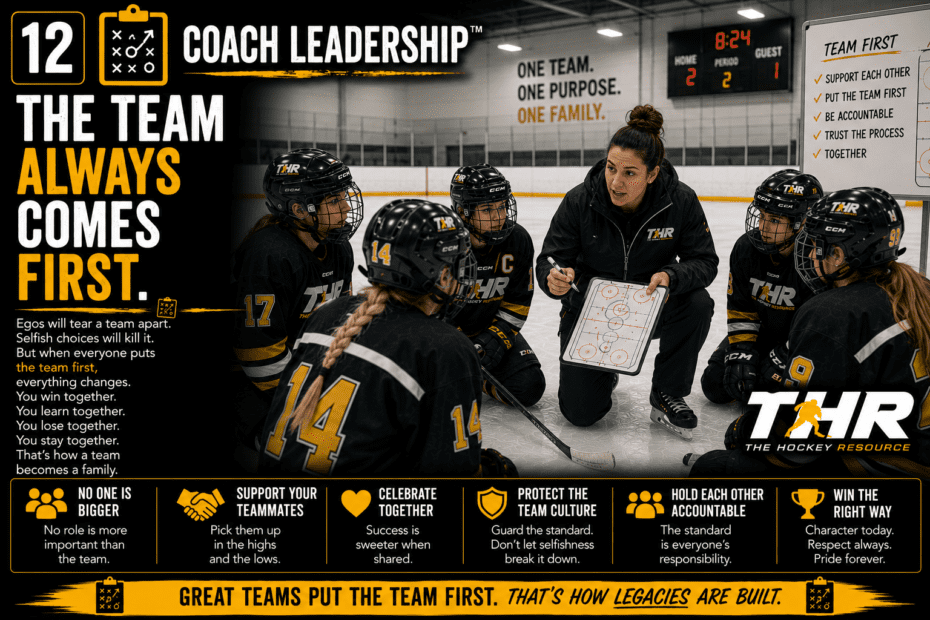
Great Teams Are Built on a Shared Purpose
Every hockey player has personal goals.
Some want more ice time.
Others want to score more goals.
Many dream about making higher-level teams.
Several hope to earn scholarships or advance their hockey careers.
Individual ambition is healthy.
Personal growth matters.
Development should always be encouraged.
However, successful teams understand a simple truth.
The team always comes first.
When athletes prioritize team success, individual success often follows naturally.
Because of that reality, one of the most important leadership responsibilities is helping players understand the value of collective commitment.
Hockey Is the Ultimate Team Sport
Few sports require teamwork to the same degree as hockey.
Players depend on one another constantly.
Forwards rely on defensemen.
Defensemen rely on goaltenders.
Goaltenders rely on teammates.
Coaches rely on players.
Success depends upon cooperation.
As a result, no individual can consistently succeed without support from the group.
Great teams recognize this connection.
Strong cultures celebrate collective achievement rather than individual recognition.
Leadership Means Sacrifice
Many leadership lessons begin with sacrifice.
Sometimes players accept reduced ice time.
Certain athletes play unfamiliar roles.
Others contribute without receiving significant recognition.
Those sacrifices help teams succeed.
Great coaches teach athletes that leadership is not always about personal achievement.
Leadership often involves putting the needs of the group ahead of personal interests.
Because of that mindset, trust develops and culture becomes stronger.
Individual Talent Has Limits
Talent wins moments.
Teams win championships.
History provides countless examples of highly skilled teams that failed because individuals prioritized themselves over the group.
Meanwhile, less talented teams frequently exceed expectations through commitment, unity, and shared purpose.
Talent remains important.
Character remains essential.
Culture often determines which team reaches its full potential.
Consequently, coaches should emphasize collaboration as much as individual performance.
Every Role Has Value
Not every player scores goals.
Not every athlete earns special teams opportunities.
Some players contribute through energy.
Others provide leadership.
Several strengthen the culture through attitude and work ethic.
Every role matters.
Successful teams understand that contribution takes many forms.
Athletes who embrace their role often help create healthier team environments.
For that reason, coaches should consistently communicate the value of every player.
Team-First Players Build Culture
Culture develops through behavior.
Selfless players influence teammates positively.
Athletes who support one another strengthen trust.
Players who celebrate teammates create belonging.
Positive actions spread throughout the group.
Eventually, those behaviors become part of the team’s identity.
As culture improves, performance often improves as well.
The strongest teams typically feature athletes who genuinely care about one another.
Adversity Reveals Commitment
Winning creates excitement.
Challenges reveal priorities.
Difficult stretches test whether players remain committed to team goals.
Injuries.
Losing streaks.
Reduced opportunities.
Unexpected setbacks.
Those situations expose character.
Strong leaders keep the group focused.
Trusted coaches reinforce team values.
Committed athletes continue supporting one another.
Because of that unity, teams often emerge stronger from adversity.
Coaches Must Model Team-First Leadership
Players watch leadership closely.
Athletes notice whether coaches place the team ahead of personal recognition.
They observe how leaders share credit.
They evaluate how success is celebrated.
They pay attention to how mistakes are handled.
Consequently, coaches must model the same team-first mindset they expect from players.
Leadership by example remains one of the most effective teaching tools in sports.
Development Happens Through Teamwork
Many life lessons emerge through team experiences.
Players learn:
- Cooperation
- Responsibility
- Respect
- Communication
- Accountability
- Leadership
- Resilience
Those lessons often become more valuable than athletic accomplishments.
Years later, former players may not remember statistics.
Many still remember the relationships, sacrifices, and teamwork that defined their experience.
That influence extends well beyond hockey.
The Legacy of Team-First Leadership
Every athlete wants to contribute.
Every player hopes to succeed.
Every coach wants development and results.
The most successful programs achieve those goals by creating environments where the team comes first.
Individual success matters.
Personal goals have value.
Team success creates something bigger.
Great coaches understand that leadership is not about producing stars.
Leadership is about building groups that work together toward a common purpose.
When athletes learn to put the team first, they become better teammates.
They often become better leaders.
Most importantly, they become better people.
The team always comes first.
The strongest cultures are built on that foundation.
PRESENTED BY: thehockeyresource.com and thehockeytournamentresource.com – mark@thehockeyresource.com
As always, thank you for being part of The Hockey Resource community.
You can find all the cards at thehockeytournamentresource.com
GUMROAD – ALL HOCKEY EBOOKS
https://thehockeyresource.gumroad.com/
CLICK LINK FOR AWESOME HOCKEY PRODUCTS – https://thehockeyresource.com/discount-hockey-products-amazon/
CLICK TO SEE MARK ON PODCAST – https://www.buzzsprout.com/1824112/episodes/13519482
Mark Hetherman
Executive Director
The Hockey Resource
mark@thehockeyresource.com
thehockeyresource.com
thehockeytournamentresource.com