

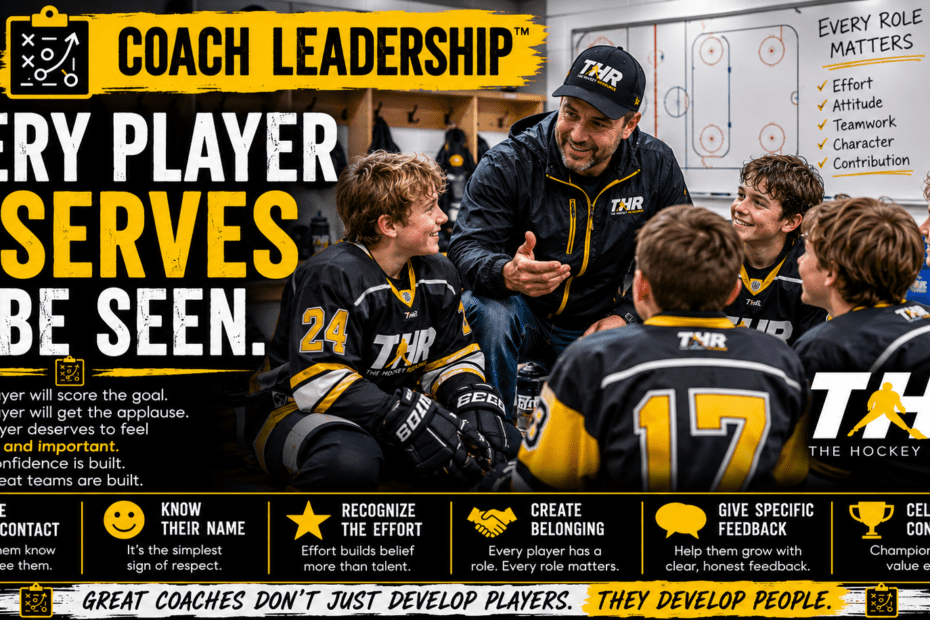
Sometimes the Most Important Player Is the One Nobody Notices
Every hockey team has star players.
Coaches naturally spend time discussing top scorers, starting goaltenders, power-play specialists, and team leaders.
Attention often follows performance.
Recognition frequently follows success.
Meanwhile, another group of players quietly moves through the season.
These athletes may not lead the team in points.
Their names may not appear in game summaries.
Few spectators notice their contributions.
Yet every player deserves to be seen.
Great coaches understand this principle.
Strong leaders recognize that development begins when athletes feel valued, respected, and connected to the team environment.
As a result, seeing every player becomes one of the most important responsibilities a coach can fulfill.
Being Seen Is About More Than Ice Time
Many people assume players only want more playing time.
Ice time certainly matters.
Opportunities remain important.
Development requires meaningful experiences.
However, most athletes are looking for something deeper.
Players want to know:
- Do I matter?
- Does my coach care?
- Am I improving?
- Does anyone notice my effort?
- Do I belong here?
Those questions influence confidence, motivation, and commitment.
Consequently, coaches who build strong relationships often create stronger development environments.
Every Player Has a Story
Each athlete arrives at the rink carrying experiences that others may never see.
Some players struggle with confidence.
Others battle anxiety.
Certain athletes face challenges at school.
Many families manage financial pressures, long commutes, or personal difficulties.
Despite those realities, players still arrive ready to compete.
Because coaches interact with athletes regularly, they possess a unique opportunity to provide encouragement and support.
A simple conversation can change a player’s day.
Sometimes it can change a season.
Occasionally, it can change a life.
The End of the Bench Matters
Championship teams often celebrate their stars.
Winning programs appreciate everyone.
Every roster includes players who receive less attention.
Some athletes play limited minutes.
Others spend significant time developing behind more experienced teammates.
Several players contribute primarily through effort, attitude, and commitment.
Without those individuals, team culture suffers.
For that reason, strong coaches intentionally connect with every athlete.
Recognition should never be reserved exclusively for top performers.
Effort deserves acknowledgment.
Character deserves appreciation.
Growth deserves celebration.
Confidence Grows Through Connection
Confidence does not always come from goals and assists.
Encouragement plays a major role.
Constructive feedback creates opportunities.
Meaningful relationships strengthen belief.
When coaches notice effort, players feel valued.
When leaders recognize improvement, athletes gain confidence.
When coaches invest time in relationships, trust develops.
As trust grows, performance often improves.
Therefore, seeing players as people becomes an essential part of development.
Small Moments Create Lasting Impact
Many coaching opportunities occur away from games.
A brief conversation before practice.
A supportive comment after a mistake.
An encouraging message following a difficult weekend.
A simple acknowledgment of effort.
Those moments may appear insignificant.
Years later, players frequently remember them.
Athletes often forget scores.
Many cannot recall standings.
Most struggle to remember tournament results.
However, they remember the coach who believed in them when confidence was low.
That influence lasts.
Building an Inclusive Team Culture
Positive cultures make room for everyone.
Successful teams value contributions beyond statistics.
Leadership includes creating environments where every player feels respected and included.
Strong cultures encourage:
- Belonging
- Respect
- Communication
- Accountability
- Support
- Growth
Because every athlete contributes differently, coaches must avoid defining value solely through performance metrics.
Character matters.
Effort matters.
Commitment matters.
Every player matters.
Development Is Not Always Immediate
Progress rarely follows a straight line.
Some athletes improve quickly.
Others require patience.
Several players develop later than expected.
History provides countless examples of players who were overlooked before achieving success.
Therefore, coaches should resist making permanent judgments based on temporary circumstances.
Potential often emerges over time.
Development requires patience.
Leadership requires vision.
Great coaches understand both.
The Legacy of Being Seen
Many years after hockey ends, former players remember how they were treated.
Athletes remember whether coaches respected them.
Players remember whether leaders believed in them.
Young people remember whether they felt valued.
Those memories shape lasting impressions.
Because of that reality, coaching extends far beyond systems and strategies.
Every player deserves to be seen.
Every player deserves encouragement.
Every player deserves respect.
Every player deserves an opportunity to grow.
The best coaches never forget that the player who needs support the most is often the one receiving the least attention.
Leadership begins when every athlete feels they matter.
PRESENTED BY: thehockeyresource.com and thehockeytournamentresource.com – mark@thehockeyresource.com
As always, thank you for being part of The Hockey Resource community.
You can find all the cards at thehockeytournamentresource.com
GUMROAD – ALL HOCKEY EBOOKS
https://thehockeyresource.gumroad.com/
CLICK LINK FOR AWESOME HOCKEY PRODUCTS – https://thehockeyresource.com/discount-hockey-products-amazon/
CLICK TO SEE MARK ON PODCAST – https://www.buzzsprout.com/1824112/episodes/13519482
Mark Hetherman
Executive Director
The Hockey Resource
mark@thehockeyresource.com
thehockeyresource.com
thehockeytournamentresource.com