

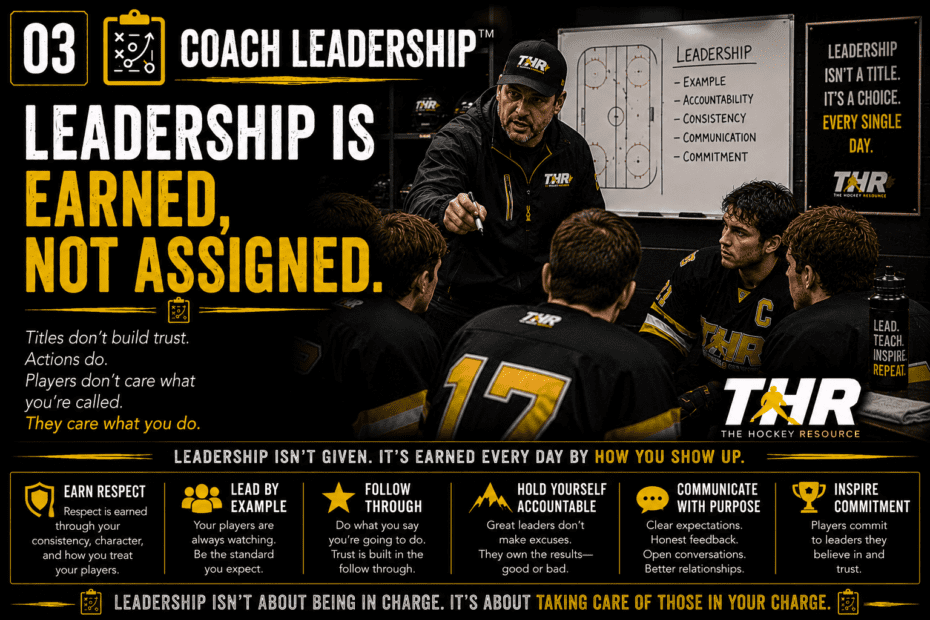
The Title Does Not Make You a Leader
Every hockey team has coaches.
Many organizations have leaders.
Not every coach earns leadership.
Not every title creates influence.
Leadership is not automatically granted when someone receives a whistle, a clipboard, or a position behind the bench. Instead, leadership develops when players, parents, staff, and fellow coaches consistently trust the person guiding them.
Because of this reality, leadership must be earned every day.
Respect cannot be demanded.
Trust cannot be forced.
Influence cannot be assigned.
All three must be earned through actions.
Players Decide Who Their Leaders Are
Athletes pay close attention to behavior.
Long before players listen to instruction, they evaluate credibility.
Young athletes ask themselves questions such as:
- Does this coach care about me?
- Is this coach fair?
- Can I trust what they say?
- Do they follow their own standards?
- Will they support me when things become difficult?
Those answers determine whether leadership exists.
Consequently, coaches who consistently demonstrate integrity often gain stronger influence than those who simply hold authority.
Trust Comes Before Leadership
Trust serves as the foundation of every successful team.
Without trust, communication becomes difficult.
Without trust, accountability becomes resistance.
Without trust, culture begins to weaken.
Strong coaches understand that trust is built through consistency.
Players trust leaders who:
- Keep their word
- Treat people fairly
- Communicate honestly
- Remain consistent
- Admit mistakes
- Put players first
As a result, trust creates the opportunity for leadership to flourish.
Leadership Is Visible in Difficult Moments
Winning games makes leadership look easy.
Adversity reveals the truth.
Pressure creates opportunities for leaders to demonstrate character.
During losing streaks, players watch carefully.
Following mistakes, athletes observe reactions.
After difficult conversations, team members evaluate credibility.
Therefore, challenging moments often become leadership moments.
The strongest coaches remain calm when others panic.
Great leaders stay consistent when circumstances become difficult.
That stability builds confidence throughout the organization.
Consistency Creates Credibility
One positive speech does not create leadership.
One successful season does not guarantee influence.
Leadership develops through repeated actions over time.
Consistency matters because players notice everything.
Athletes remember:
- How coaches respond to failure
- How leaders treat struggling players
- How staff members handle disagreements
- How standards are enforced
Eventually, consistency becomes credibility.
Credibility becomes trust.
Trust becomes leadership.
Accountability Starts with the Coach
Many coaches expect accountability from players.
The best leaders demonstrate accountability first.
Strong coaches:
- Accept responsibility
- Admit mistakes
- Learn continuously
- Seek feedback
- Model growth
When players observe accountability from leadership, they become more willing to accept responsibility themselves.
Consequently, accountability becomes part of team culture rather than simply a rule.
Respect Is Earned Through Service
Leadership is not about power.
Leadership is not about control.
Leadership is not about being the loudest voice in the room.
Effective leadership focuses on serving others.
Great coaches ask:
How can I help my players improve?
How can I create a positive environment?
How can I support long-term development?
When athletes believe a coach genuinely cares about their success, respect naturally follows.
Because of that connection, leadership becomes authentic rather than positional.
Every Interaction Matters
Many leadership opportunities happen away from games.
A conversation after practice.
A message to a struggling player.
A discussion with a parent.
An encouraging word following disappointment.
Small moments often create lasting impressions.
Years later, players rarely remember every drill.
However, they frequently remember how a coach made them feel.
That influence becomes part of a coach’s legacy.
Leadership Beyond the Bench
Strong leadership extends beyond hockey.
Players learn life lessons through daily experiences.
Communication.
Responsibility.
Resilience.
Respect.
Commitment.
Those lessons often remain long after the final game is played.
As a result, coaches have opportunities to influence far more than performance.
They help shape future leaders.
The Legacy of Earned Leadership
Every coach receives a title.
Only some coaches earn leadership.
Athletes willingly follow leaders they trust.
Parents support leaders they respect.
Organizations grow around leaders who serve others.
Because leadership is earned rather than assigned, every interaction becomes important.
Every decision matters.
Every standard matters.
Every conversation matters.
Leadership is earned through consistency, character, and commitment.
The best coaches understand that influence is never given.
It is earned every day.
PRESENTED BY: thehockeyresource.com and thehockeytournamentresource.com – mark@thehockeyresource.com
As always, thank you for being part of The Hockey Resource community.
You can find all the cards at thehockeytournamentresource.com
GUMROAD – ALL HOCKEY EBOOKS
https://thehockeyresource.gumroad.com/
CLICK LINK FOR AWESOME HOCKEY PRODUCTS – https://thehockeyresource.com/discount-hockey-products-amazon/
CLICK TO SEE MARK ON PODCAST – https://www.buzzsprout.com/1824112/episodes/13519482
Mark Hetherman
Executive Director
The Hockey Resource
mark@thehockeyresource.com
thehockeyresource.com
thehockeytournamentresource.com