

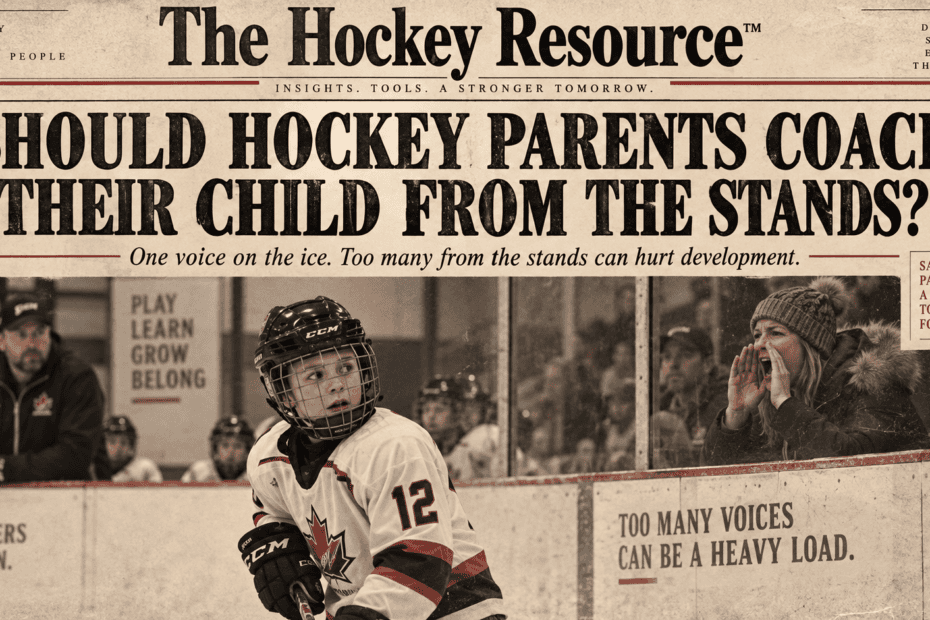
PARENTS SEARCH FOR THE HOCKEY ANSWER™
PARENTS INTELLIGENCE™
The puck moves into the offensive zone.
A young Hockey Player carries it toward the net.
From the stands, a parent yells –
“SHOOT!”
Another parent shouts –
“PASS IT!”
The coach calls for the Player to move into open space.
Meanwhile, the Player is trying to read the defense, control the puck, and make a decision in a fraction of a second.
Three different instructions.
One young Player.
And a game that will not stop while everyone offers an opinion.
This happens in Hockey arenas every weekend.
Parents want their children to succeed. They see opportunities, recognize mistakes and naturally want to help.
But does shouting instructions from the stands actually help a young Hockey Player?
Or does it interfere with the very decision-making skills we want Players to develop?
THE HOCKEY RESOURCE ANSWER™
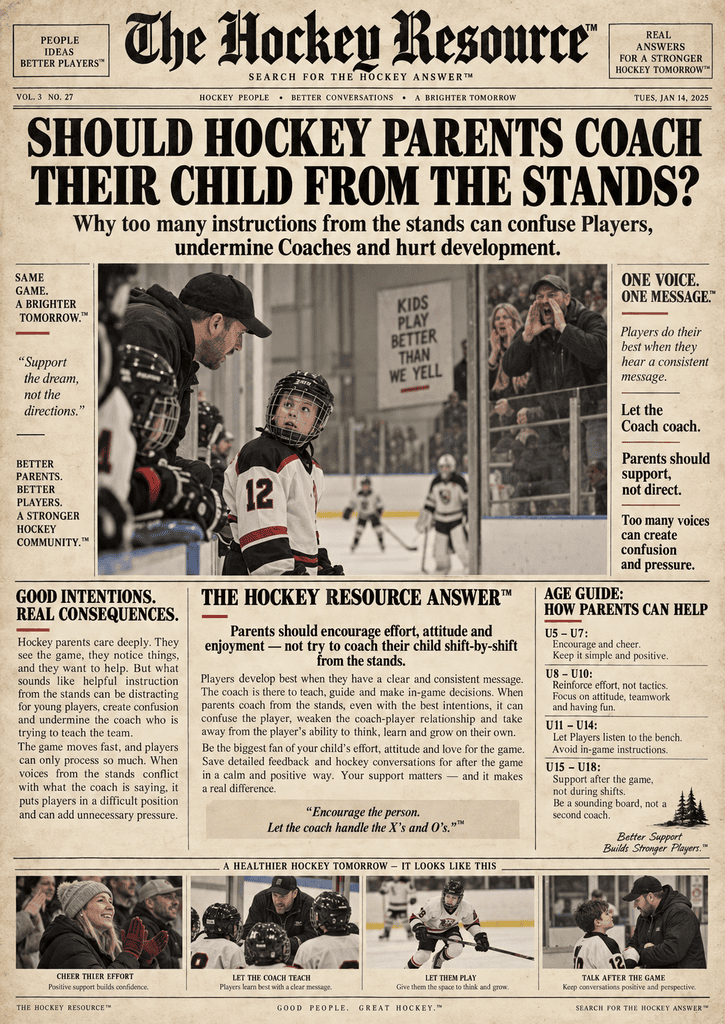
Hockey parents should encourage their children from the stands, but generally leave technical and tactical coaching to the Team’s Coaches.
Positive support can help Players feel confident, appreciated and motivated.
However, repeatedly shouting instructions during play can distract Players, create confusion and interfere with their ability to make independent decisions.
The distinction matters.
Cheering supports the Player. Coaching attempts to direct the Player.
A parent shouting “Good effort!” is offering encouragement.
A parent repeatedly yelling “Shoot!”, “Pass!”, “Skate!” or “Get back!” is attempting to influence the Player’s decisions.
Even when those instructions are technically correct, they may arrive too late or conflict with the Team’s coaching objectives.
The Hockey Resource™ believes the best approach is straightforward.
LET THE COACHES COACH. LET THE PLAYERS PLAY. LET THE PARENTS ENCOURAGE.™
Exceptions exist when immediate safety is at risk, and parents have every right to raise legitimate coaching concerns through appropriate channels. Supporting the Coach’s role does not require ignoring unsafe or inappropriate conduct.
WHY DO HOCKEY PARENTS COACH FROM THE STANDS?
Most parents are not deliberately trying to undermine the Coach.
They want to help.
A parent may see an open passing lane, an uncovered opponent or a Player skating toward danger.
The natural reaction is to offer an instruction.
Some parents have played or coached Hockey themselves. Others have developed considerable knowledge from watching games and attending practices.
Their observations may even be correct.
However, recognizing a play is different from knowing whether calling out an instruction will help the child execute it.
The Player must process several things simultaneously.
They need to control their skating, manage the puck, recognize teammates and opponents, anticipate movement and make decisions under pressure.
Adding instructions from the stands can complicate that process.
The issue is not whether parents understand Hockey.
The issue is whether the Player benefits from receiving additional instructions during the game.
CAN SHOUTING INSTRUCTIONS ACTUALLY HURT DEVELOPMENT?
It can.
Player development involves more than learning the correct Hockey decision.
It also involves learning how to recognize situations and make decisions independently.
Consider a U10 Player entering the offensive zone.
The Player sees two options.
They could shoot or pass.
If a parent immediately shouts “Shoot!”, the Player may follow the instruction without fully evaluating the situation.
That might produce a successful play.
But it does not necessarily demonstrate that the Player recognized the best option independently.
Now consider a different situation.
A parent shouts “Pass!” while the Coach has been teaching Players to attack open shooting lanes.
The Player receives conflicting messages.
The parent may be trying to help, but the instruction can interfere with the development objective.
Frequent sideline instructions can also make some children anxious about making mistakes or disappointing their parents.
Not every Player reacts the same way, and occasional encouragement is not the same as constant criticism.
Nevertheless, the distraction risk is real.
A Player who is constantly waiting for instructions may have fewer opportunities to develop independent Hockey judgment.
WHAT SHOULD HOCKEY PARENTS SAY DURING A GAME?
Parents don’t need to stay silent.
Hockey should be exciting.
Families should enjoy watching their children compete.
The important distinction is between encouragement and instruction.
Positive Encouragement
Examples include –
- “Great effort!”
- “Nice play!”
- “Keep working!”
- “Good hustle!”
- “Way to go, Team!”
These statements recognize effort, participation and positive contributions without attempting to dictate tactical choices.
Instructions Better Left to Coaches
Examples include –
- “Shoot!”
- “Pass!”
- “Get off the ice!”
- “Cover that Player!”
- “Stay on the blue line!”
Those statements direct specific Hockey actions.
During competition, the Team’s Coaches should generally manage tactical communication.
Parents can still discuss Hockey with their children when invited, but game time is rarely the best moment to provide competing instructions.
DOES THE ANSWER CHANGE WITH THE PLAYER’S AGE?
Yes. Younger Players and older competitive Players have different learning and communication needs.
U5–U7 – SHOULD PARENTS SHOUT INSTRUCTIONS TO YOUNG PLAYERS?
At U5–U7, Hockey should emphasize enjoyment, skating, participation and basic skill development.
Children are learning how to move, control equipment and understand the game.
Too many instructions can become overwhelming.
A young Player may hear a parent yelling from the stands but not understand what the instruction means.
Worse, the child may become more concerned about satisfying the parent than enjoying the activity.
THE HOCKEY RESOURCE RECOMMENDATION™
Encourage effort, celebrate participation and leave skill instruction to the Coach.
After the game, ask whether your child had fun.
Parent takeaway – At U5–U7, your voice should create enjoyment, not pressure.
U8–U10 – LET PLAYERS LEARN TO MAKE DECISIONS
During these years, Players begin recognizing basic Hockey situations and making more decisions with the puck.
They will make mistakes.
A Player may pass when shooting was the better choice.
Another might attempt to skate through several opponents instead of moving the puck.
These are learning opportunities.
If parents constantly provide answers from the stands, Players may become distracted or hesitant.
THE HOCKEY RESOURCE RECOMMENDATION™
Allow Players to recognize situations, attempt solutions and learn from the results.
Support the Coach’s teaching objectives.
Parent takeaway – Players must be allowed to make decisions before they can learn to make better decisions.
U11–U14 – BUILD HOCKEY INTELLIGENCE AND CONFIDENCE
At U11–U14, Players are learning more complex offensive and defensive concepts.
They must recognize pressure, available space, positioning and developing plays.
This stage offers important opportunities to develop Hockey intelligence.
Parents should avoid becoming an additional source of tactical instructions during competition.
Instead, encourage Players to review their decisions constructively with their Coaches.
THE HOCKEY RESOURCE RECOMMENDATION™
Promote independent decision-making, confidence and the willingness to learn from mistakes.
Parent takeaway – Developing Hockey intelligence requires opportunities to think, decide and occasionally be wrong.
U15–U18 – RESPECT PLAYER INDEPENDENCE
Older Players generally operate within more structured systems and increasingly complex Team expectations.
Coaches may assign specific responsibilities involving forechecking, defensive coverage, puck support and special Teams.
A parent shouting unrelated instructions can conflict with those responsibilities.
Older Players also need increasing independence and ownership of their development.
THE HOCKEY RESOURCE RECOMMENDATION™
Leave tactical communication to Coaches and support the Player’s ability to manage competitive situations.
When an older Player asks for your opinion, offer thoughtful feedback without undermining the Team’s instructions.
Parent takeaway – The higher the competitive level, the more important clear communication and Player independence become.
JUNIOR HOCKEY – SUPPORT THE PLAYER WITHOUT MANAGING THE GAME
Junior Hockey Players are competing in environments where tactical responsibilities, performance expectations and coaching decisions may have significant consequences.
Parents remain important sources of emotional support.
However, they should not attempt to manage game situations from the stands.
THE HOCKEY RESOURCE RECOMMENDATION™
Respect the Player’s growing independence and professional development responsibilities.
Parent takeaway – Your role is to support the person, not manage every shift.
WHAT ABOUT GOALIES – SHOULD PARENTS GIVE INSTRUCTIONS DURING GAMES?
Goalies face unique demands.
They need to track the puck, recognize developing plays, communicate with Defencemen and respond quickly to shots, screens and rebounds.
A parent shouting “Stay up!”, “Get out!” or “Watch the back door!” may distract the Goalie at precisely the moment concentration is needed.
Goalie positioning and save selection also involve technical details that are difficult to assess accurately from the stands.
THE HOCKEY RESOURCE GOALIE RECOMMENDATION™
Leave in-game technical instruction to qualified Goalie Coaches and the Team’s coaching staff.
Parents should provide encouragement and emotional support without making every goal against a teaching opportunity.
After a difficult game, a Goalie may benefit more from a reassuring conversation than an immediate breakdown of each goal.
Goalie parent takeaway – The Goalie needs to concentrate on the puck, not on instructions coming from the stands.
WHAT IF A PARENT IS ALSO A QUALIFIED HOCKEY COACH?
Hockey knowledge does not automatically change the parent’s role during someone else’s game.
A parent may possess more Hockey experience than the person coaching the Team.
That does not mean providing separate tactical instructions from the stands is helpful.
Conflicting directions remain conflicting directions.
If a parent has useful observations or a legitimate concern, they should communicate through appropriate Team channels.
A qualified Coach serving on the Team’s coaching staff has a different responsibility from a parent attending as a spectator.
THE HOCKEY RESOURCE PERSPECTIVE™
Being knowledgeable about Hockey does not mean every situation requires you to demonstrate that knowledge.
Sometimes the best contribution is allowing another Coach to teach and another Player to learn.
WHAT SHOULD PARENTS DO WHEN THEY DISAGREE WITH THE COACH?
Parents do not need to agree with every coaching decision.
Coaches can make mistakes.
A parent may have a reasonable question about instruction, communication or Player development.
However, shouting alternative directions during games is rarely the best way to resolve those concerns.
First, determine whether the disagreement involves a genuine development or safety issue or simply a different Hockey opinion.
For ordinary coaching concerns, arrange an appropriate conversation rather than confronting the Coach during competition.
Ask constructive questions.
What is the Team teaching in this situation?
What should the Player focus on?
How can parents reinforce the development objectives away from the rink?
If a matter involves safeguarding, abuse, dangerous conduct or an urgent safety concern, use the appropriate reporting or emergency procedures immediately rather than waiting for an ordinary postgame discussion.
WHAT SHOULD A PARENT SAY AFTER THE GAME?
The conversation after the game may influence how a child remembers the experience.
Some Players want to discuss their performance.
Others simply want to go home, eat something and think about something other than Hockey.
Parents should respect those differences.
Instead of beginning with –
“Why didn’t you shoot?”
Consider asking –
“Did you enjoy the game?”
Or –
“What did you think went well today?”
When a Player wants to discuss a particular play, encourage reflection.
“What options did you see?”
“What might you try next time?”
Those questions allow the Player to think independently.
They also make the parent a supportive partner rather than another evaluator.
FIVE WAYS PARENTS CAN HELP WITHOUT COACHING FROM THE STANDS
1. Encourage effort.
Recognize determination, teamwork and positive contributions.
2. Respect Coaches and Officials.
Model appropriate behaviour even when you disagree.
3. Allow mistakes.
Learning requires opportunities to try, fail, adjust and improve.
4. Ask questions instead of delivering lectures.
Encourage Players to explain their own decisions.
5. Protect the enjoyment of Hockey.
Your child should not feel that every game becomes a performance review on the drive home.
THE HOCKEY RESOURCE PERSPECTIVE™
ARE PARENTS HELPING THEIR CHILD – OR INTERRUPTING THE LEARNING PROCESS?
Hockey parents invest enormous amounts of time, money and energy supporting their children.
They deserve recognition for that commitment.
However, the desire to help can sometimes produce the opposite result.
Hockey is a decision-making sport.
Players must learn to recognize opportunities, anticipate opponents and respond to changing situations.
Coaches can teach principles and provide feedback.
But the Player must ultimately make decisions on the ice.
That learning process becomes more difficult when competing instructions arrive from several directions.
Parents should also recognize that mistakes are part of development.
A Player who passes instead of shooting may have selected the wrong option.
That does not mean the Player needs immediate correction from the stands.
It may mean the Player needs another opportunity to recognize the situation independently.
The goal of Hockey development is not to create Players who follow instructions perfectly. It is to develop Players who understand the game and make increasingly better decisions.
Parents contribute to that goal by encouraging effort, supporting learning and allowing Coaches to Coach.
THE HOCKEY RESOURCE TAKEAWAY™
Hockey parents should enthusiastically support their children.
Cheering, encouragement and recognition of effort all have a place in the arena.
However, repeatedly shouting tactical instructions can distract Players and interfere with learning.
The best approach is to establish clear responsibilities.
Coaches provide instruction.
Players make decisions and learn.
Parents encourage, support and help maintain a positive Hockey experience.
LET THE COACHES COACH. LET THE PLAYERS PLAY. LET THE PARENTS ENCOURAGE.™
A PLAYER WHO LEARNS TO THINK THE GAME CAN LEARN TO PLAY THE GAME BETTER.™
THREE WAYS TO LEARN™
ONE QUESTION. ONE RESEARCHED ANSWER. THREE WAYS TO LEARN.
READ IT. TAKE THE QUIZ. LISTEN TO THE AUDIO.
LEARN WHEN IT FITS YOUR LIFE.™
HOW WE REACHED THE HOCKEY ANSWER™
Our research can reach across Hockey organizations, development programs, current studies, expert guidance, public discussion and real-world Hockey experience to find the strongest information available. We compare the evidence, challenge the obvious answer, consider how age, level, position and circumstances may change it, and then combine everything into one clear Hockey answer designed to help you make a better decision.
As always, thank you for being part of The Hockey Resource Community.
AMAZON Hockey https://thehockeyresource.com/hockey-products-amazon/
NEW Tournament Search APP
https://play.google.com/store/apps/details?id=com.hockeyresource.hockeytournamentapp&hl=en_CA&pli=1
NEW!!! The Hockey Moments Cards
GUMROAD – eBooks
https://thehockeyresource.gumroad.com
SEE My Interview with the Mental Health Academy