


COACH JANE™ AND COACH JOEY™ EXPLAIN THE HOCKEY ANSWER
ONE QUESTION. TWO COACHES. TWO PERSPECTIVES. ONE BETTER HOCKEY ANSWER.™
Every young Hockey Player wants to shoot harder.
But what actually makes a wrist shot powerful?
Is it stronger arms? Better equipment? More practice? Or is there something happening throughout the body that young Players need to understand?
The Hockey Resource™ asked Coach Jane™ and Coach Joey™ to explain the wrist shot from two Player-development perspectives.
Their teaching priorities are slightly different, but both Coaches agree on one essential principle:
A better wrist shot starts with better technique, not simply greater arm strength.
THE HOCKEY RESOURCE ANSWER™
A harder wrist shot develops through coordinated movement of the legs, hips, torso, arms, hands, and Hockey stick.
Physical strength contributes to shooting power, particularly as Players mature. However, greater strength alone does not guarantee a faster or more accurate shot.
Research on wrist-shot biomechanics links trunk rotation to puck speed. Other research links shooting accuracy to full-body movement.
That means Coaches should teach young Players how their movements work together, not simply tell them to swing harder.
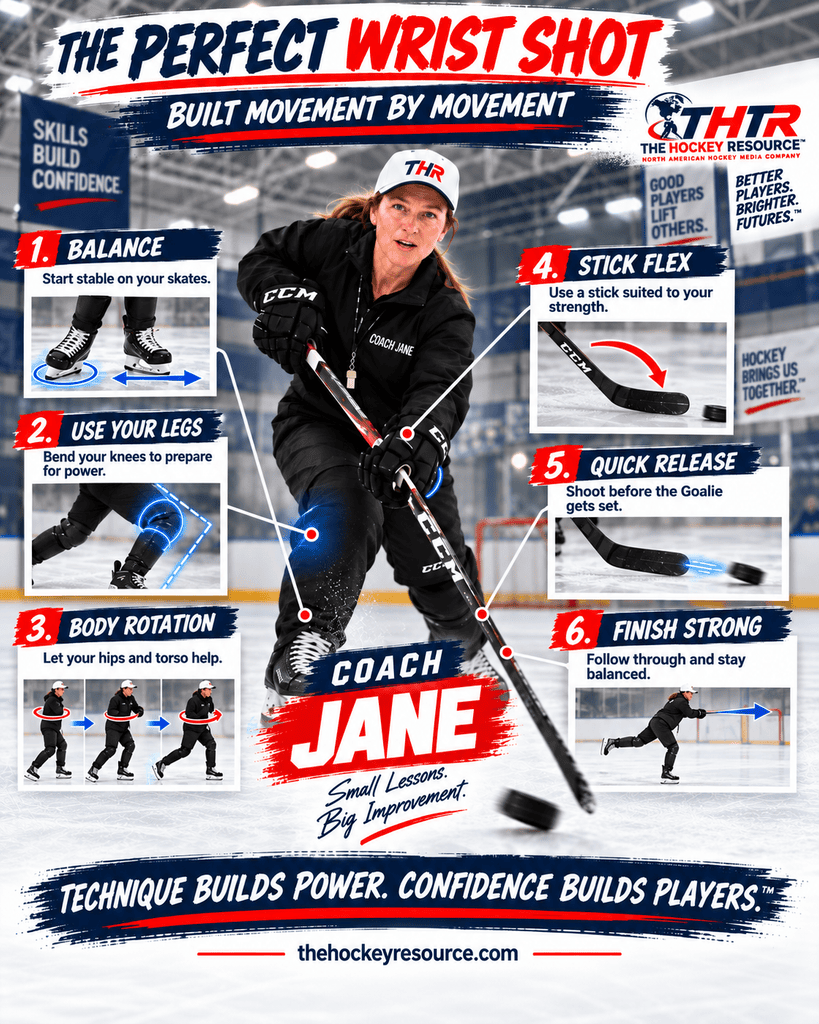
COACH JANE™ – GENERATING SHOT SPEED THROUGH TECHNIQUE
TECHNIQUE BUILDS POWER. CONFIDENCE BUILDS PLAYERS.™
Coach Jane™ wants young Female Hockey Players to understand that shooting power is a skill they can develop.
Girls do not need a fundamentally different wrist-shot technique. However, instruction should account for individual strength, physical maturity, confidence, and equipment.
Here are Jane’s six teaching priorities.
1. Balance: Start Stable
A controlled shot begins with a comfortable, balanced skating position.
The Player should move naturally, with slightly bent knees and enough stability to control the puck.
2. Use Your Legs: Prepare for Power
The legs provide an important foundation for shooting.
A comfortable knee bend allows the Player to maintain balance and coordinate lower-body movement with the rest of the shot.
3. Body Rotation: Let Your Whole Body Help
The hips and torso contribute to shooting speed.
Instead of relying entirely on the arms, Players can learn to rotate their bodies in a controlled movement that supports the release.
The goal is coordination, not exaggerated twisting.
4. Stick Flex: Match Your Equipment to Your Development
The Hockey stick should be appropriate for the Player’s size, strength, and skill.
A stick that is too stiff may be difficult for a developing Player to load effectively. Length, blade pattern, and control also matter.
No single flex number is appropriate for every Girl of the same age.
5. Quick Release: Give the Goalie Less Time
A hard shot is useful. A quick, accurate shot may be even more effective.
Coach Jane encourages Players to practise controlling the puck and releasing it without unnecessary preparation.
6. Finish Strong: Stay Balanced
A natural follow-through completes the shooting movement.
After releasing the puck, the Player should recover balance and prepare for the next play.
COACH JANE’S TAKEAWAY™
Your strength will develop over time. Your technique can improve with every practice.
Learn the movement, develop confidence, and keep getting better.
CONFIDENCE TODAY. BRIGHTER TOMORROW.™
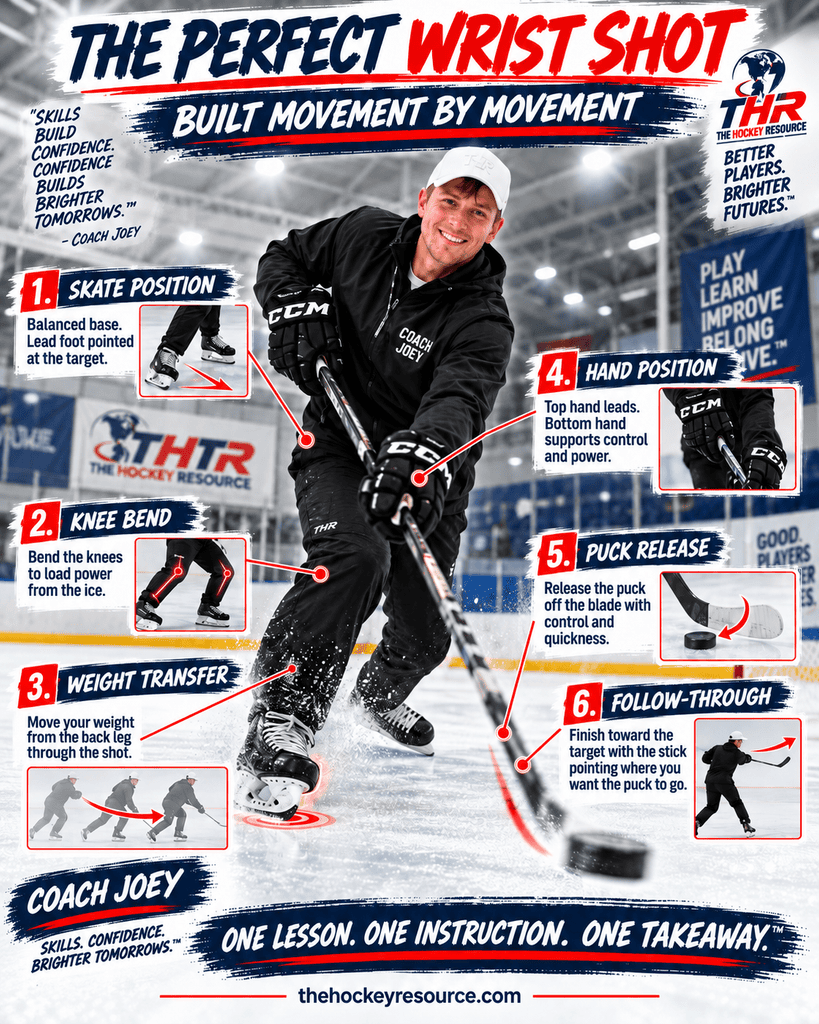
COACH JOEY™: BUILDING WRIST SHOT POWER THROUGH MOVEMENT
A BETTER SHOT STARTS WITH A BETTER MOVEMENT.™
Coach Joey™ emphasizes how young Players can connect individual movements into one effective shot.
Strength helps, but poor coordination can keep a Player from using it effectively.
Joey breaks the wrist shot into six teaching points.
1. Skate Position: Build an Athletic Base
Start with a comfortable skating stance.
The Player needs enough stability to control the puck while remaining ready to move.
2. Knee Bend: Prepare the Lower Body
A slight knee bend helps the Player stay athletic.
Rigid legs can make it harder to coordinate the shooting motion.
3. Weight Transfer: Move Through the Shot
For a traditional stationary wrist shot, shifting weight through the shot helps coordinate the lower and upper body.
The exact movement changes when shooting in stride, so Players should eventually learn both.
4. Hand Position: Control the Stick
The top and bottom hands work together.
The top hand guides and controls the stick, while the bottom hand adds leverage.
Efficient shooting requires coordinated movement.
5. Puck Release: Combine Power and Control
The Player must time the hands, stick, and body to deliver energy to the puck.
As skills improve, Players learn to release the puck efficiently without sacrificing accuracy.
6. Follow-Through: Complete the Shot
The follow-through continues the movement after the puck is released.
The Player should finish naturally, recover balance, and remain ready for a rebound or another play.
COACH JOEY’S TAKEAWAY™
Don’t simply try to shoot harder.
Learn to move better, control the puck, and combine your developing strength with effective technique.
MAKE THE GOALIE SAVE IT.™
DO BOYS AND GIRLS DEVELOP SHOOTING STRENGTH DIFFERENTLY?
This is where understanding physical development becomes important.
Before puberty, average strength differences between Boys and Girls are generally smaller.
As puberty progresses, Boys typically experience larger average increases in muscle mass and muscular strength.
However, individual development varies considerably.
A Girl with efficient shooting mechanics may produce a more effective shot than a stronger Boy with poor technique. The reverse may also be true.
The important lesson is that biological averages do not determine an individual Player’s ability or potential.
Both Boys and Girls benefit from technical instruction, appropriate strength development, and equipment suited to their abilities.
The fundamental mechanics of a wrist shot are not separated by gender. Good Coaching responds to the individual Player.
WHAT BOTH COACHES AGREE ON
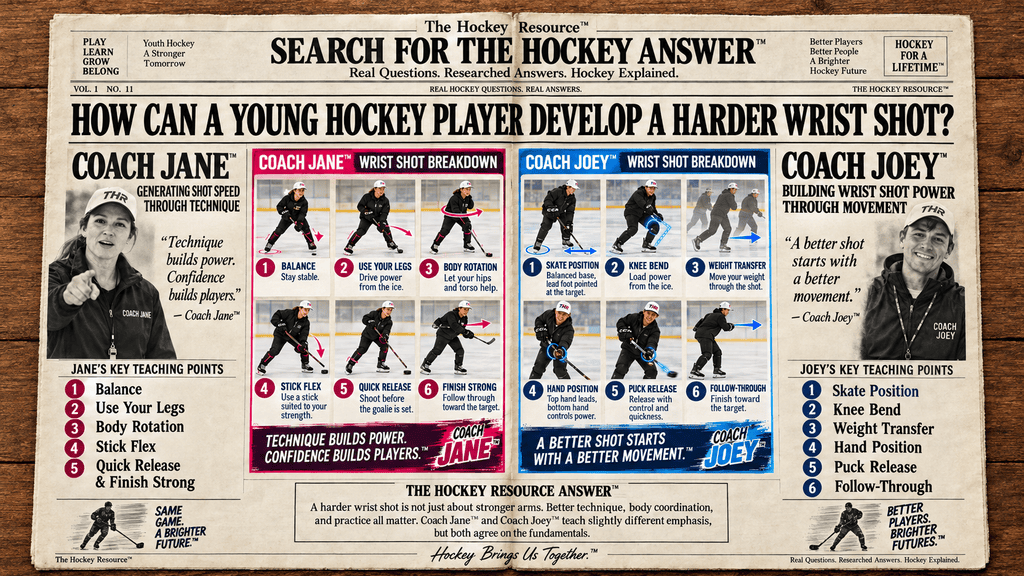
Coach Jane™ and Coach Joey™ share six fundamental teaching principles:
- Balance creates the foundation.
- Legs contribute to shooting power.
- The torso helps coordinate the movement.
- Proper hand positioning improves control.
- A clean release makes the shot more effective.
- Continued practice helps technique become more consistent.
The Coaches may emphasize different elements depending on the Player, but the underlying Hockey principles remain the same.
WHAT SHOULD A YOUNG PLAYER PRACTISE?
The most useful starting point depends on age and current ability.
U5–U7: Enjoy Shooting
Use appropriate equipment, simple targets, and short exercises. Celebrate effort and puck control rather than shot speed.
U8–U10: Learn the Movement
Introduce balance, knee bend, hand positioning, and smooth puck release. Concentrate on one improvement at a time.
U11–U14: Connect Technique and Power
Develop coordinated body rotation, weight transfer, shooting while skating, and release timing.
Players mature at different rates, so avoid comparing development solely by shot speed.
U15–U18: Apply Shooting Skills Under Pressure
Combine sound shooting mechanics with appropriate strength training, quicker releases, deception, and realistic game situations.
A PRACTICAL WRIST-SHOT CHALLENGE
Coach Jane™ and Coach Joey™ recommend a simple three-round exercise.
Round 1: Five controlled shots
Focus on balance and puck contact.
Round 2: Five shots with movement
Use your legs and body to support the shot.
Round 3: Five quick-release shots
Receive or move the puck, then shoot accurately without an unnecessary windup.
Ask the Player:
Did you stay balanced? Did you use your whole body? Did you make the Goalie save it?
The objective is improvement, not simply recording the hardest possible shot.
WHAT DID YOU LEARN?™
Question: What is the most important foundation for developing a harder wrist shot?
A. Stronger arms are all that matter.
B. Better coordination of the legs, body, hands, and Hockey stick.
C. Buying the stiffest Hockey stick available.
Correct answer: B.
Strength matters, but coordinated technique helps Players use their strength effectively.
If the answer is incorrect, explain the principle and let the Player try again.
THE FINAL HOCKEY RESOURCE ANSWER™
A harder wrist shot is not developed simply by swinging the arms harder.
It develops when the Player learns to combine balance, lower-body movement, torso rotation, hand control, and efficient puck release.
Coach Jane™ emphasizes technique, equipment fit, quick release, and confidence.
Coach Joey™ emphasizes coordinated movement, weight transfer, and developing shot power.
Both Coaches teach the same essential Hockey truth:
BETTER TECHNIQUE. BETTER SHOTS. BETTER HOCKEY PLAYERS.™
HOW WE REACHED THE HOCKEY ANSWER™
Our research can reach across Hockey organizations, development programs, current studies, expert guidance, public discussion and real-world Hockey experience to find the strongest information available. We compare the evidence, challenge the obvious answer, consider how age, level, position and circumstances may change it, and then combine everything into one clear Hockey answer designed to help you make a better decision.
As always, thank you for being part of The Hockey Resource Community.
AMAZON Hockey https://thehockeyresource.com/hockey-products-amazon/
NEW Tournament Search APP
https://play.google.com/store/apps/details?id=com.hockeyresource.hockeytournamentapp&hl=en_CA&pli=1
NEW!!! The Hockey Moments Cards
GUMROAD – eBooks
https://thehockeyresource.gumroad.com
SEE My Interview with the Mental Health Academy