

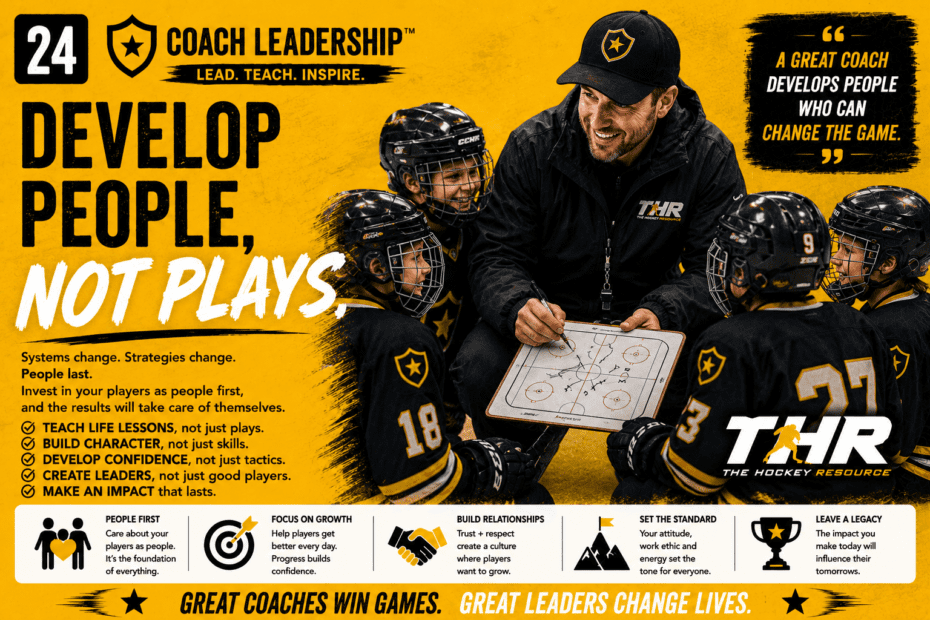
Great Coaches Teach Hockey. Great Leaders Teach Life.
Every hockey coach teaches systems.
Practice plans focus on skills.
Game preparation emphasizes tactics.
Team meetings often discuss execution.
Those responsibilities matter.
Player development depends on them.
Winning frequently requires them.
However, the greatest coaches understand something larger.
Plays change.
Systems evolve.
Strategies come and go.
People last.
Because of that reality, the most important responsibility of coaching is not simply developing better hockey players.
The true mission is to develop better people.
Hockey Is About More Than Hockey
Most players begin their journey hoping to improve.
Athletes want more ice time.
Young competitors dream of championships.
Many aspire to play at higher levels.
Those goals are valuable.
Yet hockey offers something even more important.
The game teaches life.
Every season presents opportunities to learn:
- Accountability
- Discipline
- Leadership
- Communication
- Respect
- Resilience
- Teamwork
- Responsibility
Those lessons often become more valuable than goals, assists, or championships.
Years later, players may forget statistics.
The character they develop often remains forever.
Every Interaction Is a Teaching Moment
Leadership does not happen only during games.
Development does not occur only during practice.
Every interaction teaches something.
A conversation after a mistake.
A response during adversity.
A discussion about effort.
A moment of encouragement.
Those experiences shape how athletes think, behave, and grow.
Consequently, coaches influence far more than hockey performance.
They influence people.
Character Is a Competitive Advantage
Many organizations focus heavily on talent.
Strong programs value character equally.
Talent may help players succeed temporarily.
Character supports success for a lifetime.
Athletes with strong character often demonstrate:
- Accountability
- Work ethic
- Commitment
- Integrity
- Leadership
- Coachability
Because those qualities influence every aspect of development, coaches should intentionally teach them.
Character is not an accidental outcome.
Character develops through consistent leadership.
Confidence Changes Lives
Confidence affects everything.
Athletes compete differently when they believe in themselves.
Players learn faster when they trust their abilities.
Young people take positive risks when confidence exists.
Great coaches understand that confidence can be built.
Encouragement matters.
Support matters.
Belief matters.
Sometimes a coach sees potential before the athlete sees it themselves.
That belief often becomes a turning point.
For that reason, confidence should be viewed as an essential coaching responsibility.
Relationships Drive Development
The strongest coaching relationships are built on trust.
Trust improves communication.
Communication improves learning.
Learning improves performance.
Everything becomes connected.
Athletes are more willing to accept feedback from leaders they trust.
Players respond positively when they feel respected.
Consequently, relationship-building becomes one of the most valuable investments a coach can make.
Development happens faster when relationships exist.
Leadership Is About Influence
Many people associate coaching with authority.
Great leaders focus on influence.
Athletes watch behavior.
Players observe preparation.
Teams notice consistency.
Because of that reality, leadership is often demonstrated through actions rather than words.
A coach who models accountability teaches accountability.
A coach who demonstrates respect teaches respect.
A coach who values people teaches others to do the same.
Leadership becomes visible every day.
Success Should Be Measured Differently
Championship banners are impressive.
Winning seasons create excitement.
Player advancement generates pride.
Those accomplishments tell only part of the story.
The full measure of coaching success includes:
- Confidence developed
- Character strengthened
- Relationships built
- Values taught
- Lives influenced
Great coaches understand that long-term impact matters as much as short-term results.
The scoreboard reflects performance.
People reflect leadership.
The Players You Develop Become Tomorrow’s Leaders
Every player eventually leaves the game.
Some become coaches.
Others become parents.
Many become business leaders, teachers, first responders, or community volunteers.
The lessons learned through hockey often travel with them.
Because of that influence, coaching carries enormous responsibility.
The standards taught today often shape future generations.
Leadership becomes a legacy.
The Legacy of a Coach
Players may forget systems.
Athletes often forget specific drills.
Many cannot remember every game.
What they remember are the people who influenced them.
They remember coaches who believed in them.
They remember leaders who challenged them.
They remember adults who cared about them as people.
Great coaches win games.
Great leaders change lives.
Developing plays helps teams perform.
Developing people helps them thrive.
The coaches who understand that difference create the greatest impact of all.
PRESENTED BY: thehockeyresource.com and thehockeytournamentresource.com – mark@thehockeyresource.com
As always, thank you for being part of The Hockey Resource community.
You can find all the cards at thehockeytournamentresource.com
GUMROAD – ALL HOCKEY EBOOKS
https://thehockeyresource.gumroad.com/
CLICK LINK FOR AWESOME HOCKEY PRODUCTS – https://thehockeyresource.com/discount-hockey-products-amazon/
CLICK TO SEE MARK ON PODCAST – https://www.buzzsprout.com/1824112/episodes/13519482
Mark Hetherman
Executive Director
The Hockey Resource
mark@thehockeyresource.com
thehockeyresource.com
thehockeytournamentresource.com