

It Is Probably Not Who You Think
Every hockey team has talented players.
Top scorers attract attention.
Starting goaltenders receive recognition.
Captains often become the focus of leadership conversations.
Those players matter.
Every athlete matters.
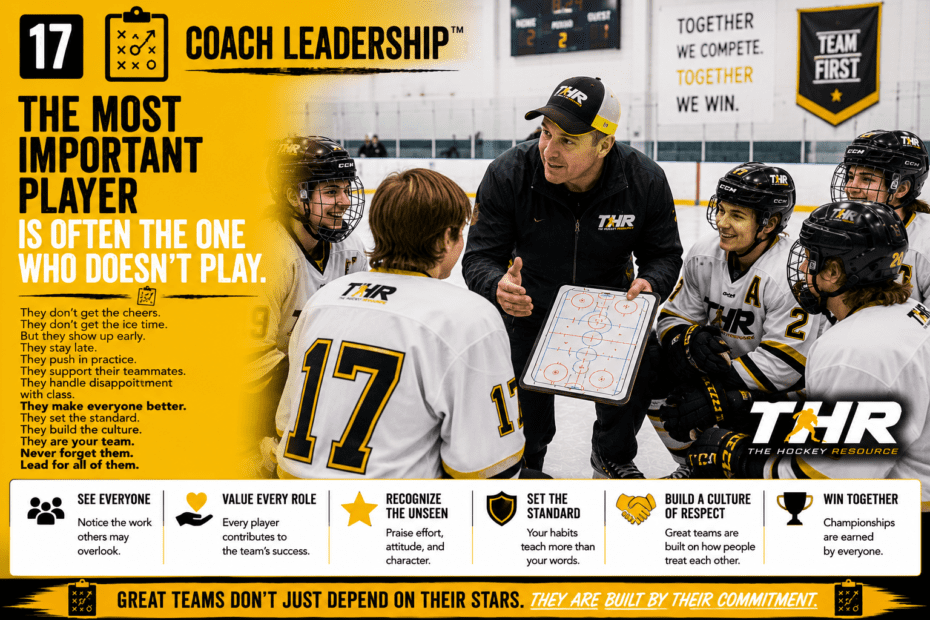
Yet the most important player on your team may not be the one leading the league in points.
The most important player is often the one who needs you the most.
Perhaps it is the player losing confidence.
Maybe it is the athlete questioning whether they belong.
Sometimes it is the quiet player standing at the edge of the group.
Occasionally it is the individual considering leaving the game altogether.
Because of that reality, great coaches look beyond statistics and standings.
They look for people.
Every Player Has a Different Journey
Development is rarely identical.
Some athletes improve quickly.
Others require patience.
Certain players mature earlier.
Many develop later.
Life circumstances also vary.
Confidence levels differ.
Family situations differ.
Learning styles differ.
Consequently, coaches must understand that every athlete brings a unique story to the rink.
The strongest leaders recognize those differences and adjust their approach accordingly.
The Player Nobody Notices
Most teams have a player who quietly moves through the season.
That athlete may not receive significant ice time.
Recognition may be limited.
Opportunities sometimes appear fewer.
Despite those challenges, they continue showing up.
They continue working.
They continue hoping.
For that player, one conversation can change everything.
A simple acknowledgment.
A word of encouragement.
A moment of belief.
Those actions may seem small.
Their impact can be enormous.
Confidence Is Often Fragile
Many young athletes struggle privately.
Mistakes create doubt.
Competition creates pressure.
Comparisons create insecurity.
Social media can amplify those challenges.
As a result, confidence becomes fragile.
Great coaches understand that confidence is not always visible.
The player smiling in practice may still be struggling.
The athlete working hard may still question their ability.
Therefore, leadership requires awareness.
Sometimes the most important coaching responsibility is helping a player believe in themselves again.
Development Is More Than Performance
Statistics tell only part of the story.
Goals matter.
Assists matter.
Wins matter.
Development matters more.
Athletes improve in many different ways.
Confidence grows.
Leadership emerges.
Communication improves.
Resilience develops.
Character strengthens.
When coaches focus solely on performance metrics, they risk missing important growth occurring beneath the surface.
The best leaders celebrate development in all its forms.
Attention Is a Leadership Tool
Where coaches invest attention often determines what players value.
Athletes notice who receives feedback.
Players observe who receives encouragement.
Teams recognize where leadership focus exists.
Strong coaches intentionally invest time in every player.
The athlete who feels unseen often benefits most from attention.
Because of that reality, leadership requires balance.
Development opportunities should not be reserved exclusively for top performers.
Relationships Create Opportunity
Trust grows through relationships.
Communication improves through relationships.
Development accelerates through relationships.
Athletes are more willing to accept feedback from coaches who genuinely know them.
Players become more engaged when they feel valued.
Confidence increases when athletes feel connected.
As a result, relationship-building becomes one of the most important responsibilities of coaching.
Every meaningful connection creates an opportunity for growth.
The Future Is Impossible to Predict
Hockey history is filled with overlooked players.
Late bloomers.
Unexpected success stories.
Athletes who developed long after others stopped believing.
Many future leaders begin as quiet contributors.
Several successful players were once considered average prospects.
Because potential is difficult to measure accurately, coaches should resist making permanent judgments based on temporary circumstances.
The player who appears ordinary today may become extraordinary tomorrow.
Great Coaches See What Others Miss
Leadership often involves seeing possibilities others overlook.
Strong coaches identify potential.
Trusted leaders recognize effort.
Exceptional coaches notice character.
Those observations help athletes feel valued.
That feeling often becomes a turning point.
The most important player is not always the best player.
The most important player is frequently the one who needs support, encouragement, and belief.
The Legacy of a Coach
Years from now, players may forget systems.
Athletes may forget scores.
Many will forget tournament standings.
People remember how they were treated.
Former players often remember the coach who noticed them when others did not.
They remember encouragement during difficult times.
They remember leaders who believed in them before they believed in themselves.
That influence becomes part of a coach’s legacy.
Every athlete matters.
Every player deserves attention.
Every individual deserves an opportunity to grow.
The most important player on your team may not be standing in the spotlight.
The most important player may be waiting for someone to notice.
Great coaches always do.
PRESENTED BY: thehockeyresource.com and thehockeytournamentresource.com – mark@thehockeyresource.com
As always, thank you for being part of The Hockey Resource community.
You can find all the cards at thehockeytournamentresource.com
GUMROAD – ALL HOCKEY EBOOKS
https://thehockeyresource.gumroad.com/
CLICK LINK FOR AWESOME HOCKEY PRODUCTS – https://thehockeyresource.com/discount-hockey-products-amazon/
CLICK TO SEE MARK ON PODCAST – https://www.buzzsprout.com/1824112/episodes/13519482
Mark Hetherman
Executive Director
The Hockey Resource
mark@thehockeyresource.com
thehockeyresource.com
thehockeytournamentresource.com