

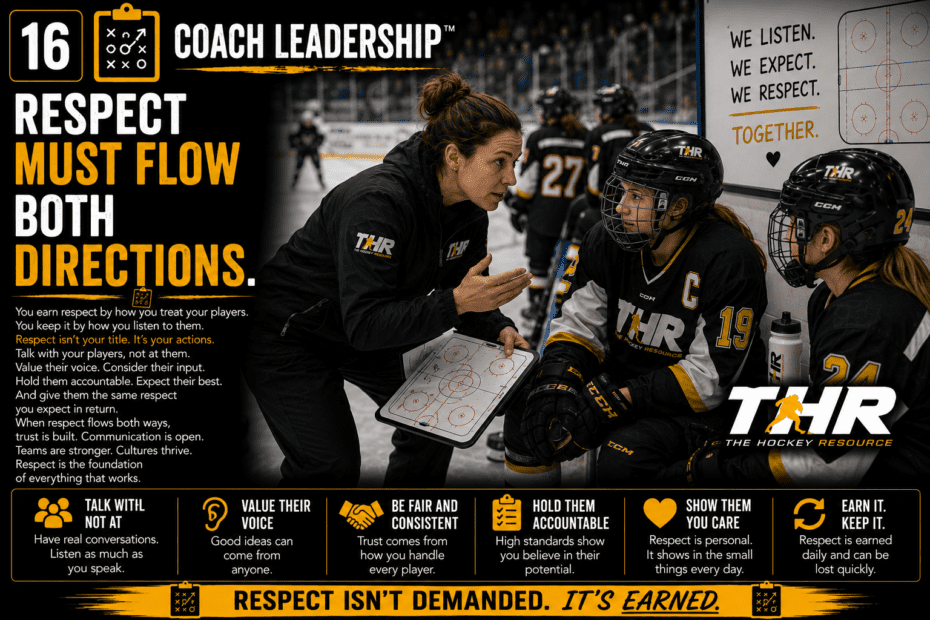
Respect Is the Foundation of Every Great Team
Every hockey organization talks about respect.
Many coaches demand respect.
Players are told to respect authority.
Parents are encouraged to respect volunteers.
Those expectations are important.
However, respect cannot be a one-way street.
The healthiest hockey environments understand a simple truth.
Respect must flow both directions.
Coaches should respect players.
Players should respect coaches.
Parents should respect volunteers.
Volunteers should respect families.
Officials deserve respect.
Teammates deserve respect.
When respect becomes part of the culture, trust grows, communication improves, and teams become stronger.
Because of that reality, respect remains one of the most valuable leadership tools available.
Respect Is Earned Through Daily Actions
Titles create responsibility.
Positions create authority.
Neither automatically creates respect.
Players evaluate leadership every day.
Athletes observe behavior.
They watch how coaches communicate.
They notice how leaders handle adversity.
They pay attention to fairness.
Consequently, respect is often earned through consistent actions rather than words.
Great coaches understand this principle.
They lead by example.
They demonstrate professionalism.
They model the behavior they expect from others.
Players Want to Feel Valued
Every athlete wants development.
Every player hopes to improve.
Young people also want to feel respected.
Athletes appreciate coaches who:
- Listen
- Communicate honestly
- Treat people fairly
- Support development
- Maintain consistency
- Show genuine care
When players feel respected, trust grows naturally.
As trust grows, relationships become stronger.
As relationships improve, development often accelerates.
Everything becomes connected.
Coaches Deserve Respect Too
Respect must work both ways.
Players have responsibilities.
Athletes should:
- Arrive prepared
- Listen attentively
- Support teammates
- Demonstrate accountability
- Follow team standards
Strong team cultures encourage mutual responsibility.
Coaches who invest countless hours into development deserve professionalism and effort from their athletes.
Successful programs recognize that respect strengthens every relationship within the organization.
Communication Reflects Respect
The way people communicate often reveals the level of respect within a team.
Constructive conversations create trust.
Active listening demonstrates value.
Honest feedback promotes growth.
Supportive communication encourages confidence.
Conversely, negative interactions create division.
Poor communication damages culture.
For that reason, respectful communication should become a daily expectation.
Great leaders understand that how something is said often matters as much as what is said.
Respect During Adversity
Winning makes respect easier.
Challenges reveal character.
Close losses.
Reduced ice time.
Mistakes.
Disappointment.
Pressure.
Those moments test leadership.
Strong coaches remain respectful during difficult situations.
Trusted leaders avoid emotional reactions.
Successful athletes maintain professionalism.
Because respect remains consistent, relationships often survive difficult circumstances.
Team Culture Depends on Respect
Culture develops through everyday interactions.
Positive environments encourage inclusion.
Healthy cultures value people.
Strong programs create belonging.
Respect influences:
- Communication
- Accountability
- Trust
- Teamwork
- Leadership
- Development
Without respect, culture weakens.
With respect, culture strengthens.
Therefore, respect should never be viewed as optional.
It should become part of the team’s identity.
Respect Extends Beyond Hockey
The lessons learned in hockey often follow players throughout life.
Athletes eventually become employees.
Many become parents.
Some become coaches.
Others become business leaders.
Respect remains valuable in every environment.
Coaches who model respect help athletes develop skills that extend far beyond the game.
Because of that influence, leadership carries lasting significance.
Leadership Begins With Respect
Many people associate leadership with authority.
Great coaches understand leadership begins with relationships.
Relationships require trust.
Trust requires respect.
Respect requires consistency.
Everything starts with how people are treated.
The most effective leaders understand that influence is earned through daily interactions.
Respect remains one of the strongest ways to build that influence.
The Legacy of Respect
Players often forget systems.
Athletes rarely remember every drill.
Many cannot recall specific practice plans years later.
What they do remember is how they were treated.
They remember coaches who listened.
They remember leaders who cared.
They remember environments where people mattered.
Respect is not weakness.
Respect is not softness.
Respect is leadership.
The best coaches understand a simple truth.
Respect must flow both directions.
When it does, trust grows.
When trust grows, culture strengthens.
When culture strengthens, teams thrive.
PRESENTED BY: thehockeyresource.com and thehockeytournamentresource.com – mark@thehockeyresource.com
As always, thank you for being part of The Hockey Resource community.
You can find all the cards at thehockeytournamentresource.com
GUMROAD – ALL HOCKEY EBOOKS
https://thehockeyresource.gumroad.com/
CLICK LINK FOR AWESOME HOCKEY PRODUCTS – https://thehockeyresource.com/discount-hockey-products-amazon/
CLICK TO SEE MARK ON PODCAST – https://www.buzzsprout.com/1824112/episodes/13519482
Mark Hetherman
Executive Director
The Hockey Resource
mark@thehockeyresource.com
thehockeyresource.com
thehockeytournamentresource.com